• 0 Items - £0.00
    • No products in the cart.

£34.99

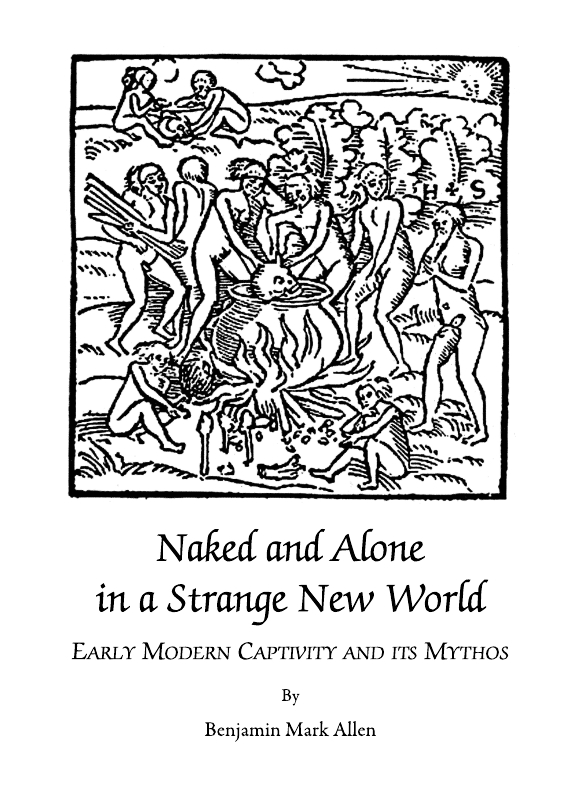
Naked and Alone in a Strange New World

Early Modern Captivity and its Mythos
By: Benjamin Mark Allen

£34.99

This analysis of early modern captivity narratives argues the harrowing tales are not historically accurate. Instead, they are cultural artifacts that offer insight into the mentalities of the age, aiding understanding of sixteenth-century peoples and societies.

Naked and Alone is a comparative analysis of early modern captivity narratives that chronicle the harrowing experiences of a few Iberians and one Hessian in…
£34.99
£34.99
1-4438-1250-1 , ,
Share

Naked and Alone is a comparative analysis of early modern captivity narratives that chronicle the harrowing experiences of a few Iberians and one Hessian in the New World during the century of exploration and colonization. Included among them are the tales of Jerónimo de Aguilar and Gonzalo Guerrero, Álvar Núñez Cabeza de Vaca , Juan Ortiz, Hans Stade, and Francisco Núñez de Pineda y Bascuñán. After years of captivity that stripped the unfortunate men of their cultural identity, they eventually reunited with their countrymen to relate and record tales that rivaled the heroic epics. The authors thus provided most Europeans with a first glimpse into exotic New World societies considered strange and perhaps even diabolical by the colonizers. At the same time, most contemporaries used the narratives as justification for imperial prerogatives although the captives themselves came away with a deeper understanding of and appreciation for their Indian captors.
Although considered by some early historians as reliable texts, the captivity narratives are rejected by this author as historically accurate depictions of the experiences—faulty memories, contemporary myth, and the authors’ subjectivity greatly impeded the veracity. He instead argues that the texts are cultural artifacts that offer useful insight to the mentalities of the age. In order to construct a histoire des mentalities, the author incorporates anthropological perspectives of myth and employs textual/contextual analysis to unlock the deeper meanings often obscured by the literary imagery. What results is an interpretation that aids understanding of sixteenth-century peoples and societies, and of the post-colonial American cultures most directly influenced by them.

Benjamin Mark Allen is a transatlantic scholar and assistant professor of history at South Texas College in McAllen. He also serves as an area chair regarding captivity narratives for the Southwest/Texas Popular Culture and American Culture Association.

Hardback

  • ISBN: 1-4438-1250-1
  • ISBN13: 978-1-4438-1250-4
  • Date of Publication: 2009-10-12

Ebook

  • ISBN: 1-4438-1605-1
  • ISBN13: 978-1-4438-1605-2
  • Date of Publication: 2009-10-12
185

Subject Codes:

  • BIC: HB, HBLH, HBTB
  • BISAC: HIS051000, HIS038000, HIS054000, LIT020000, LIT024010, LIT004100
  • THEMA: NH(3MD), NHTB(3MG)
185
  • Captivity narratives are among the most fascinating and puzzling accounts of the early modern period. On the surface each of them appears as a world in itself, showcasing a unique native society doing the capturing and the tribulations of a European captive. By probing deeply into half a dozen captivity narratives of the 16th and early 17th centuries, Benjamin M. Allen is able to illuminate the narrative strategies, goals, and archetypes that are common to all of these extraordinary accounts and thereby opens an unexpected window into the mindset of that era.
    - - Andrés Reséndez Associate Professor, Department of History, University of California, Davis
  • Benjamin M. Allen has taken the captivity narrative beyond the usual images of James Fennimore Cooper and Cynthia Ann Parker, instead going back to the fifteenth century, and the earliest accounts of Europeans captured by indigenous Americans. He discusses the narrative both as first person memoir and third person account, demonstrating that these two viewpoints often influenced how the story was told. In addition, Allen considers how the stories may have been colored by the time frame between the captivity and the written narrative, and by cultural, social, political, and even literary influences. He also examines the impact of these accounts on society at the time and on subsequent attitudes and scholarship. Although written for the specialist, Allen's work is valuable to anyone interested in the captivity genre, as well as those who want to learn more about the early Spanish colonial period. It is singular and an important contribution to the field.
    - - Charles M. Robinson III author of A Good Year to Die: The Story of the Great Sioux War and Satanta: The Life and Death of a War Chief

Meet The Author

Processing Your Order

Please wait while we securely process your order.
Do not refresh or leave this page.
You will be redirected shortly to a confirmation page with your order number.