• 0 Items - £0.00
    • No products in the cart.

£47.99

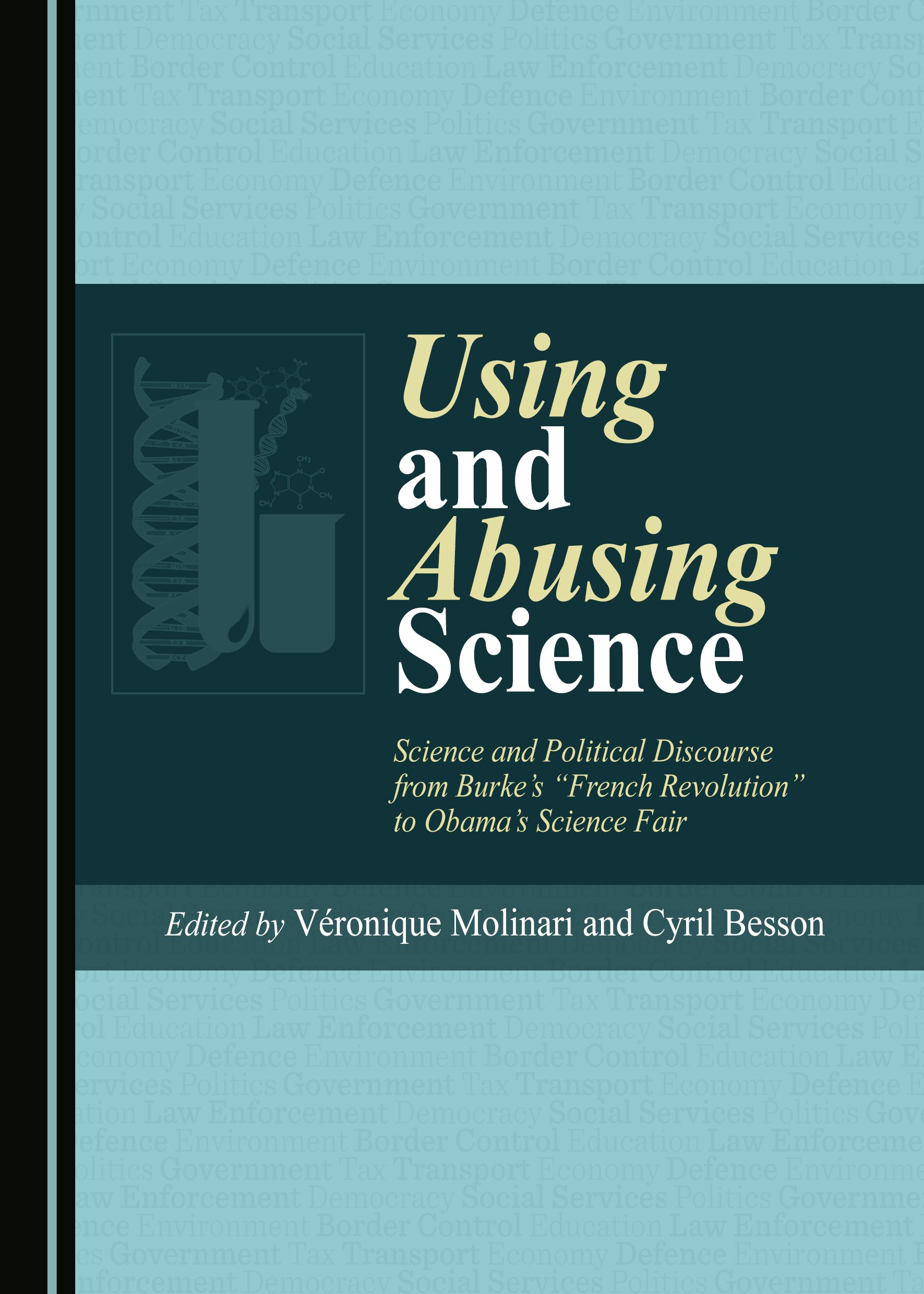
Using and Abusing Science

Science and Political Discourse from Burke’s “French Revolution” to Obama’s Science Fair
Edited By: Cyril Besson, Véronique Molinari

£47.99

This title explores how, and to what extent, science has been used by politicians to add legitimacy to their discourse over the past three centuries, and provides an illuminating illustration of the relationship between science and the political.

Over the last two centuries, as politics has evolved from the status of “amateurship” to that of profession, political discourse, together with its practices and…
£47.99
£47.99
Share

Over the last two centuries, as politics has evolved from the status of “amateurship” to that of profession, political discourse, together with its practices and their validity, has been increasingly subject to questioning. Politicians, as illustrated by the low turnouts that have recently characterised general elections and a general lack of interest in politics throughout Western countries, enjoy less than ever the trust of the electorate, and their discourse is now often criticised for being both hollow and untrustworthy. Conversely, by evolving from the status of enlightened amateur to that of expert, the figure of the scientist has, over recent centuries, gained credibility with the general public. Even though the traditional view of science as the expression of reality has regularly been challenged, science continues to be held in high regard and is believed to provide a reliable form of knowledge. Summoning science has thus often been a way, in everyday life, advertising and the popular media, to lend authority to a discourse, and imply that one’s claims are beyond dispute. That politicians should have occasionally been tempted to do the same and make up for the deficit of legitimacy of their discourse through the instrumentalisation of scientific arguments or participation in contemporaneous debates on scientific issues is, therefore, not surprising.

The issue at stake in this volume is to examine how, and to what extent, this process may have been taking place in the past three centuries. In order to accomplish this, the contributions cover various fields of expertise, ranging from the “hard” sciences to more controversial types of science, investigating the intricate relations of science and political discourse.

Véronique Molinari is Professor of British Studies at Grenoble Alpes University, France, where she teaches British History. Her research focuses on the women’s movement in Edwardian and interwar Britain, as well as on women’s participation in politics. She is co-editor (with Donna Spalding-Andreolle) of Women and Science, 17th Century to Present: Pioneers, Activists and Protagonists (2011), and the author of several books and articles including “‘Schools of their own’ – The Ladies’ Medical College and London School of Medicine for Women” (2011) and “Educating and Mobilizing the New Voter: Interwar Handbooks and Female Citizenship in Great-Britain, 1918–1931” (2014).

Cyril Besson is a Senior Lecturer in Scottish Studies at Grenoble Alpes University, France. A specialist of nineteenth-century Scottish literature, he has worked on the concepts of nation and nationhood, authority and the various modes of “naturalisation” of the arbitrariness of social and cultural constructs. He co-edited the issue of the electronic journal Representation (CEMRA) on “History and Political Discourse” with Véronique Molinari and the book Ville et environnement: regards croisés sur le monde postcolonial (2014) with André Dodeman.

Gregory Benedetti, Julie Homchick, Christian Leblond, Marc Lenormand, Jean-Louis Marin-Lamellet, Jeffrey Mullins, Sarah Peyroux-Roblin, Cyril Besson

Hardback

  • ISBN: 1-4438-8945-8
  • ISBN13: 978-1-4438-8945-2
  • Date of Publication: 2016-04-19

Ebook

  • ISBN: 1-4438-9418-4
  • ISBN13: 978-1-4438-9418-0
  • Date of Publication: 2016-04-19

Subject Codes:

  • BIC: PDX, JPA, JP
  • THEMA: PDX, JPA, JP
260