
• 0 Items - £0.00
    • No products in the cart.

From £37.99

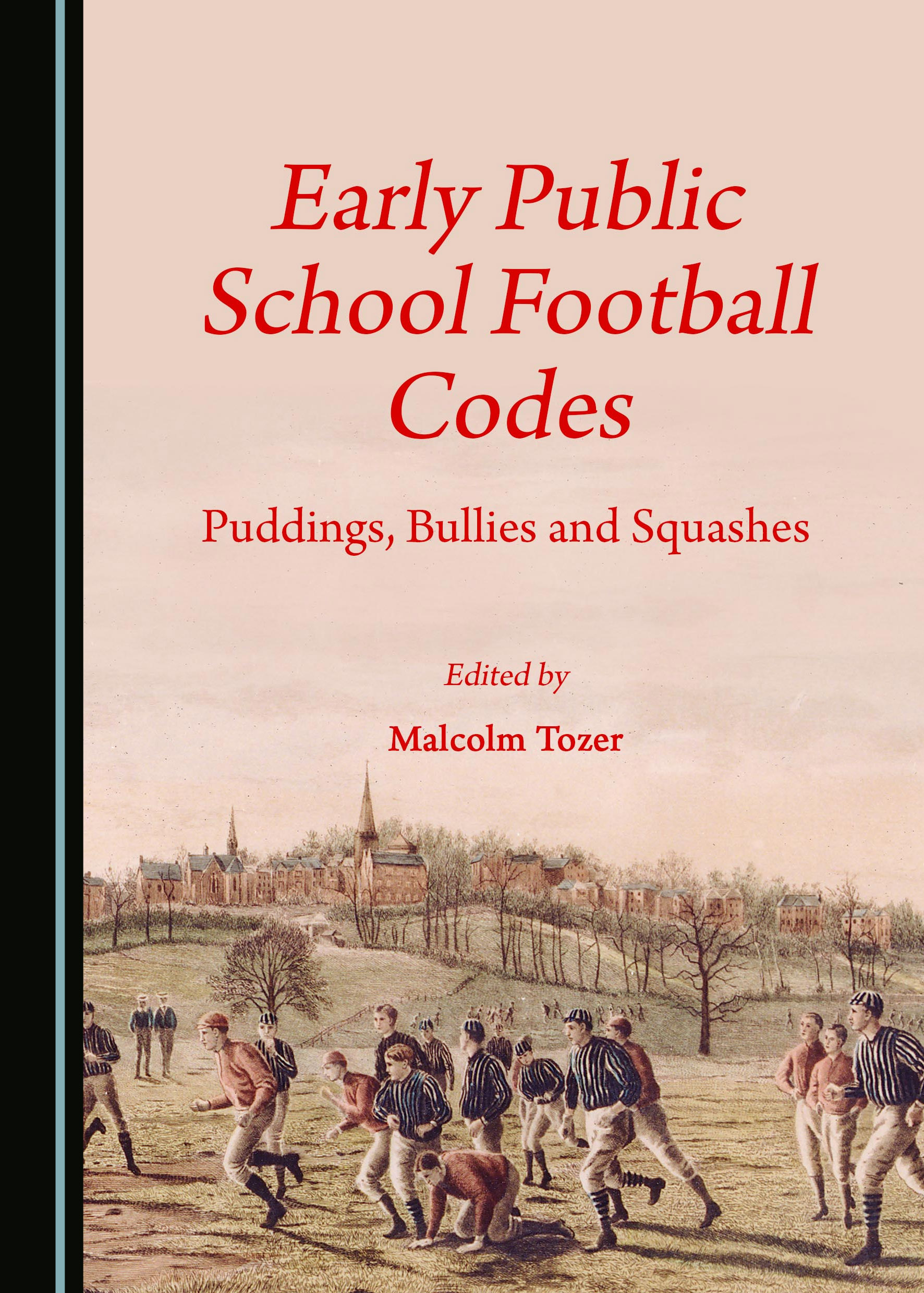
Early Public School Football Codes

Puddings, Bullies and Squashes
Edited By: Malcolm Tozer

From £37.99

Puddings, bullies, squashes. These were the names for the brutal melee of early football, when half a school battled the other. Uncover the lost codes that existed before the FA and RFU rewrote the rules and nationalised the game.

Puddings, bullies and squashes were terms used at Radley, Uppingham and Charterhouse to describe the melee, a feature of every early public school football game:…
From £37.99
From £37.99
1-5275-8222-1 , ,
Share

Puddings, bullies and squashes were terms used at Radley, Uppingham and Charterhouse to describe the melee, a feature of every early public school football game: half the school in one team attempting to drive the ball through the goal of the other half of the school in defence. The scrum of modern rugby is a pale imitation and soccer’s defensive wall just a flimsy substitute by comparison. This is the story of those early public school codes before the nationalisation of football by the FA from 1863 and the RFU from 1871.

The 20 schools are Bradfield College, Charterhouse, Christ’s Hospital, Clongowes Wood College, Durham School, Edinburgh Academy, Eton College, Forest School, Harrow School, King’s School Canterbury, Marlborough College, Radley College, Repton School, Rugby School, Sherborne School, Shrewsbury School, Tonbridge School, Uppingham School, Westminster School and Winchester College. With a preface by sports historian Tony Collins tracing the sweep of these remarkable innovative versions of football.

Malcolm Tozer taught at Uppingham School from 1966 until 1989. For six years from 1989 to 1995, he was Northamptonshire Grammar School’s first Headmaster and then Headmaster of Wellow House School for a further 10 years. In retirement, he has led inspections for the Independent Schools Inspectorate, lectured at the University of Buckingham, served as a governor at Repton School and Foremarke Hall, and promoted partnerships in physical education and sport between state and independent schools. His books include Physical Education and Sport in Independent Schools (2012), The Ideal of Manliness: The Legacy of Thring’s Uppingham (2015), and Edward Thring’s Theory, Practice and Legacy: Physical Education in Britain since 1800 (2019)—shortlisted for the Lord Aberdare Literary Prize awarded by the British Society of Sports History.

Lucy Norman, Malcolm Bailey, Mike Barford, Declan O’Keeffe, Andrew Beales, Duncan Mennie, Andrew McMillan, Angus Graham-Campbell, Peter Adams, Dale Vargas, Peter Henderson, Gráinne Lenehan, Clare Sargent, Paul Stevens, David Ray, Robert Hands, Jonathan Russell, David Walsh, David Roy, Steve Bailey, Tony Collins, Malcolm Tozer

Hardback

  • ISBN: 1-5275-8222-1
  • ISBN13: 978-1-5275-8222-4
  • Date of Publication: 2022-04-21

Paperback

  • ISBN: 1-5275-9552-8
  • ISBN13: 978-1-5275-9552-1
  • Date of Publication: 2023-03-28

Ebook

  • ISBN: 1-5275-8223-X
  • ISBN13: 978-1-5275-8223-1
  • Date of Publication: 2023-03-28
405

Subject Codes:

  • BIC: W, WS, WSJ
  • THEMA: W, SC, SF
405
  • ‘For anyone interested in the history or sociology of sport, and football in particular, this book will be of great interest. […] An abundance of sporting detail which might otherwise be consigned to the archives and annals of the respective schools makes for interesting reading. […] For its range of detail, much of it unfamiliar, this book sits on a reading list alongside the work of Dunning and Sheard and Mangan. [It] serves as a very readable charting of the nascent forms of football and offers further evidence of the significant role public schools played in the development of footballing codes.”
    - Adam Morton Sport, Education and Society
  • “[This] is a valuable book for anyone interested in the various nineteenth-century football codes and in the traditions of Britain’s (overwhelmingly England’s) public schools, as well as their linkage to the modern games of association football and rugby.”
    - Paul McFarlane European Studies in Sports History
  • “[This book is] an anthology of meticulously researched essays from twenty public schools that detail the origins of early football codes. [It] makes a valuable addition to the corpus of work that details the development of games during the Victorian public-school era. […] Due to its anthological nature, it can be dipped into as a reference work or read as a whole to provide a rich, vibrant, humorous and sometimes harrowing exposition of Victorian philosophy, invention and life. I recommend this book to casual readers with an interest in the development of football as well as to history scholars and educators.”
    - Ruan Jones History of Education Researcher
  • “Malcolm Tozer has put together an important collection packed with insights and anecdotes. The chapters are written in an enlightening manner by excellent researchers, with more than 160 illustrations further assisting readers in their understanding of the period. [The book] is a significant contribution to the study of football and will be an important reference book for a wide audience interested in both the association and rugby games. […] The authors have painted a vivid picture of football in the nineteenth century. […] That most of Tozer’s contributors should provide the original rules or laws for early football at their respective schools or colleges has resulted in an impressive historical record.”
    - Jonty Winch The International Journal of the History of Sport
  • “As well as rich in history, chapters teem with relatable anecdotes. […] That Eton figures at all in [the book] is quite a feat. For these inclusions acknowledge that this school has been fundamental in developing the global phenomenon of football, a game played and consumed by billions today. We Etonians make much of our Prime Ministerial legacy; perhaps we ought to make more of our footballing one.”
    - Ali Hirji Kheraj The Eton Chronicle
  • “[This book] fills a gap in the market and is much needed as an important supplement and research resource for future scholars. [It] uncovers one part of the early years of the development of football and provides more information on a mightily complex story. […] The many illustrations and photographs, there are no fewer than one hundred and sixty-four, add to the flavour of the book. […] It is wholeheartedly recommended for the casual reader and the serious researcher.”
    - Graham Curry Soccer & Society
  • “If you have fond memories of boarding school or are a sports historian then you will find this book fascinating. […] Prepare for a hit of nostalgia and a history lesson rolled into one.”
    - Kitty Chrisp Scottish Field
  • “There are fascinating similarities in how forms of football emerged within entirely separate communities, usually with rules reflecting the environment in which the games were played. Most were brutal in nature and many characterised by the feature to which the book’s title refers, an amorphous, scrum-type assembly, confined around the ball to advance its progress. Some had defined playing numbers and locations: others involved most members of the school simultaneously. […] This book will appeal to readers with interest in the history of all forms of football, and the considerable influence which the public schools had in elevating these pastimes to the carefully structured, worldwide games that they have become today.”
    - Neil Rollings Independent Coach Education
  • ‘This insightful and original book […] will be of interest to followers of all seven of the major football codes; to those interested in both the football and other sporting developments in the public schools in the mid-to-late 19th century; and there is plenty to ponder for the historians of both Association and Rugby football. […] Each chapter provides interesting insights into the development of various aspects of each of the worldwide football codes and it is tempting to try to follow lines of rule development or specific playing features from a single source or school, such as the fair catch rule of American Football (that) can be found in the early rules of a number of the schools reviewed here.”
    - Timothy Chandler Sport History Review
  • “A couple of things leap out from reading Early Public School Football Codes. The first is how violent those early games were. The other is how most matches […] were based around the scrum rather than the individual, the mass not the maestro. […] Each public school played a form of football by their own laws, as they were grandly called, until a meeting at the Freemasons’ Tavern near Covent Garden in 1863 agreed a common system. The story of the game’s development in these schools is admirably told in a collection of essays edited by Malcolm Tozer.”
    - Patrick Kidd The Times