

View more
This product has multiple variants. The options may be chosen on the product page
Is There an End of Ideologies?
Exploring Constructs of Ideology and Discourse in Marxist and Post-Marxist Theories
Is ideology just a political pejorative? Can we be free from it? To clarify misunderstandings about the key concepts of ideology and discourse, this book traces their origins, their appropriation by Marxist theorists, and examines the relationship between them.
Is ideology just a political pejorative? Can we be free from it? To clarify misunderstandings about the key concepts of ideology and discourse, this book traces their origins, their appropriation by Marxist theorists, and examines the relationship between them.
View more
This product has multiple variants. The options may be chosen on the product page
View more
This product has multiple variants. The options may be chosen on the product page
£47.99
The philosophical debate on truth has exploded in recent years. Sparked by the struggle over deflationism, the discussion has broadened and deepened. The essays in this book highlight how much is left to explore and how real progress can be achieved.
The philosophical debate on truth has exploded in recent years. Sparked by the struggle over deflationism, the discussion has broadened and deepened. The essays in this book highlight how much is left to explore and how real progress can be achieved.
View more
This product has multiple variants. The options may be chosen on the product page
View more
This product has multiple variants. The options may be chosen on the product page
Fictional Names
A Critical Study of Some Theories Not Committed to the Existence of Fictional Entities
What are we naming when we use terms like Sherlock Holmes? If we are speaking about nothing, how do we understand it? This book critiques theories denying existence to fictional characters, analyzing their contribution to the meaning of sentences and our thoughts.
What are we naming when we use terms like Sherlock Holmes? If we are speaking about nothing, how do we understand it? This book critiques theories denying existence to fictional characters, analyzing their contribution to the meaning of sentences and our thoughts.
View more
This product has multiple variants. The options may be chosen on the product page
View more
This product has multiple variants. The options may be chosen on the product page
Lines of Thought
Rethinking Philosophical Assumptions
In this innovative book, philosopher Claudio Costa argues that old philosophical ideas should be reworked, not dismissed. He challenges contemporary analytical philosophy's views on language, knowledge, and free will, aiming to restore a broader, more comprehensive perspective.
In this innovative book, philosopher Claudio Costa argues that old philosophical ideas should be reworked, not dismissed. He challenges contemporary analytical philosophy’s views on language, knowledge, and free will, aiming to restore a broader, more comprehensive perspective.
View more
This product has multiple variants. The options may be chosen on the product page

View more
This product has multiple variants. The options may be chosen on the product page
£44.99
Paolo Casalegno was a brilliant and probing philosopher and one of the best minds in a generation. His essays in the philosophy of logic and language are remarkable for their rigour, originality, and fundamental insights.
Paolo Casalegno was a brilliant and probing philosopher and one of the best minds in a generation. His essays in the philosophy of logic and language are remarkable for their rigour, originality, and fundamental insights.
View more
This product has multiple variants. The options may be chosen on the product page
View more
This product has multiple variants. The options may be chosen on the product page
£44.99
While Searle’s theory of social reality shapes the debate, it faces sharp criticism. This book approaches the issue from another angle, retracing the concept's origins to move beyond language-based analysis and debate the very nature of reality.
While Searle’s theory of social reality shapes the debate, it faces sharp criticism. This book approaches the issue from another angle, retracing the concept’s origins to move beyond language-based analysis and debate the very nature of reality.
View more
This product has multiple variants. The options may be chosen on the product page
View more
This product has multiple variants. The options may be chosen on the product page
£44.99
Discover ancient Chinese theories of knowledge, where a structured cosmos mirrors the mind. This book offers a vital epistemological alternative, challenging the dominance of Euro-American models and filling a crucial gap in Western thought.
Discover ancient Chinese theories of knowledge, where a structured cosmos mirrors the mind. This book offers a vital epistemological alternative, challenging the dominance of Euro-American models and filling a crucial gap in Western thought.
View more
This product has multiple variants. The options may be chosen on the product page
View more
This product has multiple variants. The options may be chosen on the product page
Inference, Consequence, and Meaning
Perspectives on Inferentialism
Inferentialism holds that an expression's meaning depends on the inferential rules governing its use. This collection of essays explores various case studies to discuss to what extent the central tenets of this theory are tenable.
Inferentialism holds that an expression’s meaning depends on the inferential rules governing its use. This collection of essays explores various case studies to discuss to what extent the central tenets of this theory are tenable.
View more
This product has multiple variants. The options may be chosen on the product page
View more
This product has multiple variants. The options may be chosen on the product page
A Theory of Literary Explication
Specifying a Relativistic Foundation in Epistemic Probability, Cognitive Science, and Second-Order Logic
This book forges a middle way between the postmodern view of infinite interpretations and the intentionalist view of one. Drawing on multidisciplinary research, it provides a foundation for judging some explications of a literary work to be better than others.
This book forges a middle way between the postmodern view of infinite interpretations and the intentionalist view of one. Drawing on multidisciplinary research, it provides a foundation for judging some explications of a literary work to be better than others.
View more
This product has multiple variants. The options may be chosen on the product page
View more
This product has multiple variants. The options may be chosen on the product page
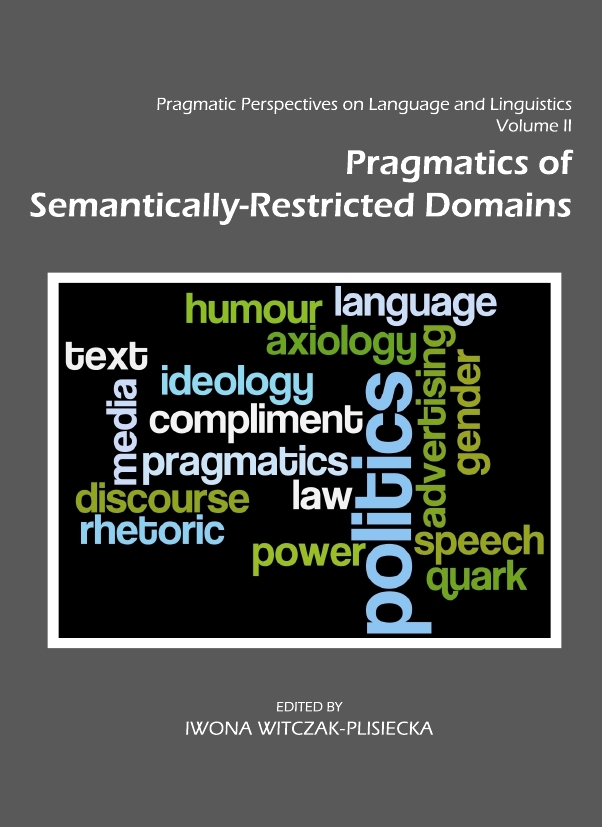
Pragmatic Perspectives on Language and Linguistics Volume II
Pragmatics of Semantically-Restricted Domains
This volume focuses on pragmatics-oriented analyses of semantically-restricted domains. It addresses phenomena from a variety of perspectives, exploring politics, ideology, humour, power, media, and specialized communication in business, law, and science.
This volume focuses on pragmatics-oriented analyses of semantically-restricted domains. It addresses phenomena from a variety of perspectives, exploring politics, ideology, humour, power, media, and specialized communication in business, law, and science.
View more
This product has multiple variants. The options may be chosen on the product page

View more
This product has multiple variants. The options may be chosen on the product page
£34.99
This book argues for a version of semanticalism, treating semantic properties as emergent and natural. They are needed to explain how linguistic expressions guide us to reality. We ought to accept semantic properties since our best theory of the world makes reference to them.
This book argues for a version of semanticalism, treating semantic properties as emergent and natural. They are needed to explain how linguistic expressions guide us to reality. We ought to accept semantic properties since our best theory of the world makes reference to them.
View more
This product has multiple variants. The options may be chosen on the product page
Processing Your Order
Please wait while we securely process your order.
Do not refresh or leave this page.
You will be redirected shortly to a confirmation page with your order number.