• 0 Items - £0.00
    • No products in the cart.

From £35.99

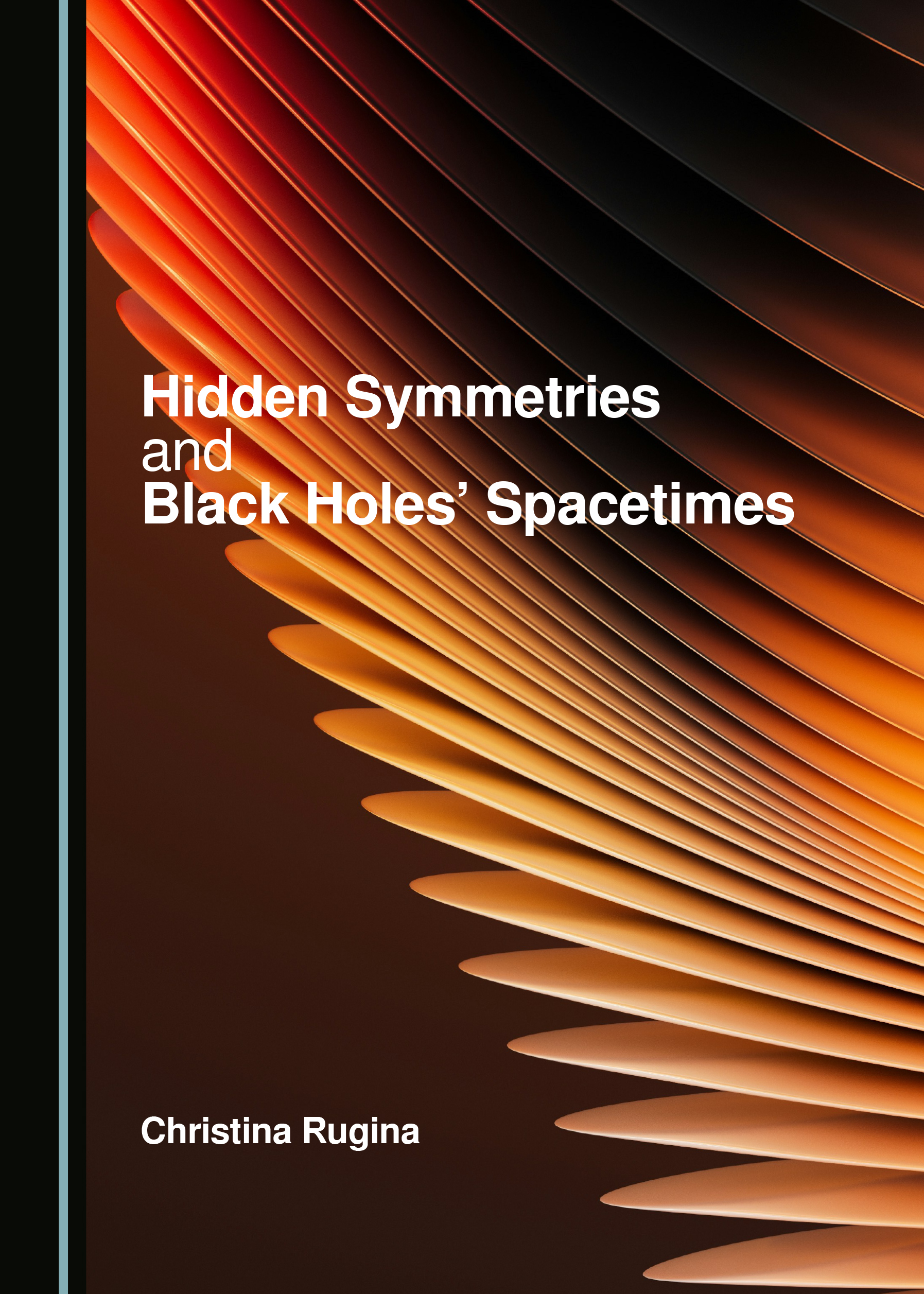
Hidden Symmetries and Black Holes’ Spacetimes

By: Christina Rugina

From £35.99

This book provides a graduate-level introduction to classical and quantum black holes. It details examples of integrable systems, hidden symmetries in black hole spacetime, and resolutions to the information paradox, presenting an overview of cutting-edge research.

This book provides a brief, graduate level introduction to the topics of classical and quantum black holes. It also details examples of integrable systems and…
From £35.99
From £35.99
Share

This book provides a brief, graduate level introduction to the topics of classical and quantum black holes. It also details examples of integrable systems and black holes’ spacetime in hidden symmetries, and resolutions to the black hole information paradox. More specifically, it presents an overview of the cutting-edge research regarding the mathematics of hidden symmetries, of black holes’ interiors, entanglement wedge reconstruction and minimal gauged 5-dimensional supergravity. It also presents novel supporting results pertaining to Kovalevskaya gyrostats spacetimes and other integrable models, a 5-dimensional minimal gauged supergravity result, fuzzball microstate solutions to non-collinear black holes’ bubbling geometries obtained from compactifying down from 11-dimensional supergravity, and an entanglement wedge reconstruction result, reconstructing a spin 1/2 from deep bulk on the boundary using a bounded operator raised at a complex power.

Christina Rugina was educated in theoretical physics and computer science at George Washington University (USA), Brandeis University (USA), Imperial College London (UK) and the University of Bucharest (Romania). She was a visiting research student at the Department of Applied Mathematics and Theoretical Physics at the University of Cambridge (UK), and she holds a PhD in theoretical physics from the University of Bucharest. She specializes in the physics of black holes and string theory.

Hardback

  • ISBN: 1-0364-1764-6
  • ISBN13: 978-1-0364-1764-2
  • Date of Publication: 2024-12-24

Ebook

  • ISBN: 1-0364-1765-4
  • ISBN13: 978-1-0364-1765-9
  • Date of Publication: 2025-09-24

Paperback

  • ISBN: 1-0364-5903-9
  • ISBN13: 978-1-0364-5903-1
  • Date of Publication: 2025-09-24

Subject Codes:

  • BIC: PHDV, PHU, PHR
  • THEMA: PHDV, PHU, PHR
258
  • "Christina Rugina's book on hidden symmetries and black holes is a fine introduction to topics of current research. It will be of interest to readers of diverse backgrounds."
    - Edward Witten Professor Emeritus at the Institute for Advanced Study, USA
  • "Symmetry is a foundational, profound concept in physics, revealing hidden mathematical structures that unify our understanding of both classical and quantum phenomena. This book explores how such hidden symmetries manifest in 4-, 5-, and 11-dimensional spacetimes, with a strong focus on black hole solutions in both classical and string-theoretic frameworks. The contents are modern, advanced, original and timely. I believe that graduate students, postdocs, and researchers working in theoretical high-energy physics, general relativity, and string theory will benefit from the author's detailed, insightful exploration."
    - Eliahu Cohen Associate Professor, Faculty of Engineering and the Institute of Nanotechnology and Advanced Materials, Bar Ilan University, Israel
  • "The book presents a valuable contribution to the field of theoretical physics, particularly in the study of hidden symmetries and black hole spacetimes. Its strength lies in the original research content and comprehensive coverage of advanced topics. The first chapter's introduction for lay audiences is particularly commendable as it makes complex concepts accessible to a broader audience."
    - Dr Behnam Pourhassan Professor in Particles and Fields, School of Physics, Damghan University, Damghan, Iran
  • "Dr. Christina Rugina's new book is a useful tool for any graduate student who wishes to study black holes and an important addition to the reading list for a black holes course. It can also serve well the lay audiences, since it contains a nice introductory chapter aimed at improving the lay audiences' understanding of Theoretical Physics at large, so it is a must have for lay audiences, specialists, students and all those who wish to go in depth in the direction of study of black holes, learn it for the first time or if they are just curious about the advances in Theoretical Physics in the past 350 years."
    - Prof Mihai Visinescu Department of Theoretical Physics, National Institute for Physics and Nuclear Engineering - "Horia Hulubei", Romania

Meet The Author