• 0 Items - £0.00
    • No products in the cart.

From £19.99

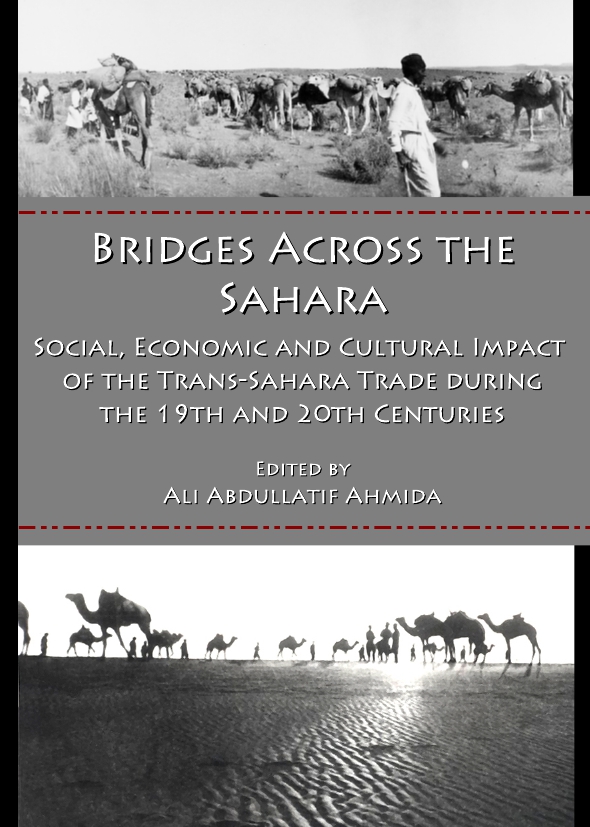
Bridges Across the Sahara

Social, Economic and Cultural Impact of the Trans-Sahara Trade during the 19th and 20th Centuries
Edited By: Ali Abdullatif Ahmida

From £19.99

This book rethinks the history of modern Africa, examining the Saharan trade not as a barrier, but as a bridge. It critiques colonial scholarship and provides an alternative narrative of the forgotten histories that linked North, Central, and West Africa.

The objective of this edited book is to rethink the history of colonial and nationalist categories and analyses of modern Africa through an integration and…
From £19.99
From £19.99
1-4438-0973-X , , ,
Share

The objective of this edited book is to rethink the history of colonial and nationalist categories and analyses of modern Africa through an integration and examination of the African Saharan trade as bridges that link the North, Central, and West regions of Africa. Firstly, it offers a critique of the colonial, postcolonial and nationalist historiographies, and also of current western scholarship on northern and Saharan Africa especially Middle East Studies and African Studies Associations. Secondly, it provides an alternative narrative of the forgotten histories of the Sahara trade as linkages between the North and the South of the Sahara.

The Sahara desert was seldom a barrier separating the northern, middle and western parts of the continent. On the contrary, the desert was and still constitutes a bridge of communication which connects northern Africa, West Africa and the countries in the southern Sahara. This connection was evident in the most important cultural, economic and social relations. Two connecting routes or bridges existed across the Sahara. First, the Hajj Routes from the north west of Africa to the holy places in Arabia. Second, are the trade routes between central and west Africa and the shores of North Africa. These trans-Sahara trade routes extend from the East Darb al-Arba’in in Egypt and Sudan to the far west borders of Senegal, Mauritania and Morocco. Hence the ties between the countries in North Africa and Wadai, Bornu, Kanim, Zender, Aer and others existed since pre-historic eras. The origins began before and were enhanced by the Islamic conquests and continued to present day.

Professor Ali Abdullatif Ahmida was born in Waddan, Libya and educated at Cairo University in Egypt and The University of Washington, Seattle, USA. He is a Professor and Chair of the Department of Political Science at the University of New England, Biddeford, Maine, USA. His specialties are political theory, comparative politics, and historical sociology. His scholarship focuses on power, agency and anti-colonial resistance in North Africa, especially modern Libya. He has published major articles in, Italian Studies, the International Journal of Middle East Studies, Arab Future, Third World Quarterly and the Arab Journal of International Studies. He is also the author of The Making of Modern Libya: State Formation, Colonialization and Resistance, a book published by State of New York University Press, 1994. This book was also translated into Arabic and is now published in its second edition by the Center of Arab Unity Studies, 1998, Beirut, Lebanon. He is the editor of Beyond Colonialism and Nationalism in the Maghrib: History, Culture and Politics, published by Palgrave Press in 2000.

Professor Ahmida has lectured in a variety of US, Canadian, European, Middle Eastern, and African universities and colleges. He has contributed several book reviews, articles and chapters to books on the African state, identity and alienation, class and state formation in modern Libya. He has received many academic grants and awards such as the Social Science Research Council national grant award, the Shahade award, and recently the Keannely Cup Award for distinguished academic service of the year at University of New England and in 2003. Routledge Press published his new book, Forgotten Voices: Power and Agency in Colonial and Postcolonial Libya, in 2005, and it was translated into Italian and Arabic editions which were published in 2009. The Center of Arab Unity Studies, Beirut, Lebanon, published his book Post-Orientalism: Critical Reviews of North African Social and Cultural History in December 2009.

Hardback

  • ISBN: 1-4438-0973-X
  • ISBN13: 978-1-4438-0973-3
  • Date of Publication: 2009-07-29

Paperback

  • ISBN: 1-4438-2674-X
  • ISBN13: 978-1-4438-2674-7
  • Date of Publication: 2010-12-15

Ebook

  • ISBN: 1-4438-1046-0
  • ISBN13: 978-1-4438-1046-3
  • Date of Publication: 2010-12-15

Subject Codes:

  • BIC: HBTR, HBJH, KCLT
  • THEMA: NHTR, NHH, KCLT
215