• 0 Items - £0.00
    • No products in the cart.

From £34.99

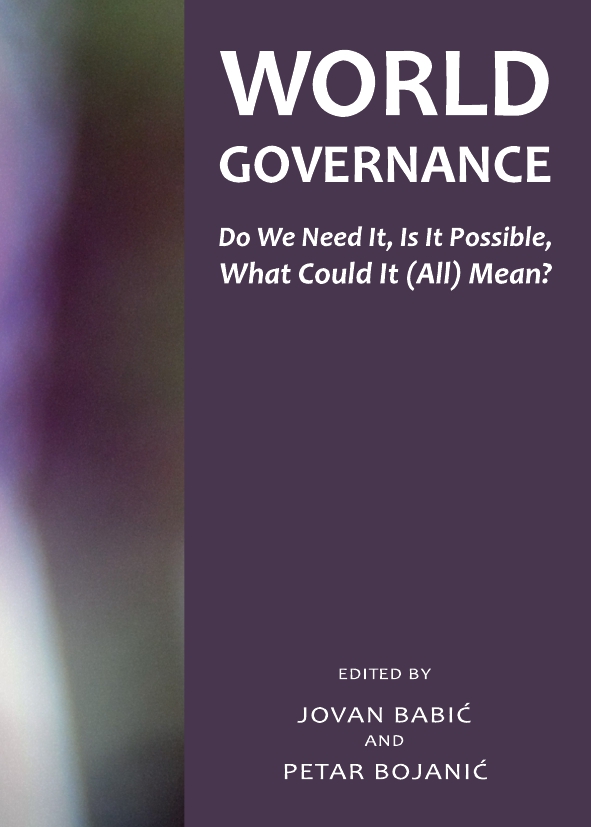
World Governance

Do We Need It, Is It Possible, What Could It (All) Mean?
Edited By: Jovan Babić, Petar Bojanić

From £34.99

Do we need a world government to ensure peace and well-being? While security and sustainability are strong arguments for it, many fear it would become tyrannical. This book explores the necessary components of an effective and just global order.

In the age of globalization and with increased interdependence in the world today, there is a question we should raise: ‘do we need, and could…
From £34.99
From £34.99
, 1-4438-2264-7 , , , ,
Share

In the age of globalization and with increased interdependence in the world today, there is a question we should raise: ‘do we need, and could we attain, a world government capable of ensuring peace and facilitating worldwide well-being in a just and efficient way?’

There are obvious and strong arguments in favour of viable and sustainable world governance, and even for a unified world state. Two such arguments seem to be especially strong: security, which is becoming more and more a matter of joint concern; and sustainability, which is increasingly visible in issues such as climate change, requiring unified and far-reaching action.

One of the main objections raised against world governance is not that it is impractical, but that it is unnecessary and even undesirable. There is a fear that world government would be, or would become, tyrannical. German philosopher Immanuel Kant devised a project of “perpetual peace,” but he was against a world state, advocating instead a kind of confederation of the states in the world. Finally, if a world government is indeed formed, how far should the instruments and tools of such a body reach?

These and other issues have been explored in this book. Covering a wide range of disciplines—from philosophy to jurisprudence, ethics, and social science—this book explores how theorists have reflected upon the necessary components of an effective global order.

Contributors to this volume include Richard Falk, Michael Walzer, Stanley Hoffman, Thomas Pogge, Jan Narveson, Larry May, Allen Buchanan, Robert Keohane, Alfred Rubin, Virginia Held, Anthony Ellis, Pauline Kleingeld, Ingeborg Maus, and Luis Cabrera.

Jovan Babić is Professor of Ethics at the University of Belgrade and Visiting Professor at Portland State University. He is the author of Kant and Scheler (1986), and Morality and Our Time (1998, 2nd ed. 2005), both in Serbian, and numerous articles (among which are: “Justifying Forgiveness,” 2000; “Foreign armed Intervention: Between Justified Aid and Illegal Violence,” in Humanitarian Intervention: Moral and Philosophical Issues, 2003; and “Toleration vs. Doctrinal Evil in Our Time,” 2004).

Petar Bojanić is Senior Research Fellow at the Centre for Ethics, Law and Applied Philosophy (CELAP) as well as the Institute of Philosophy and Social Theory (Belgrade). He received his PhD from the EHESS (France) and the University of Paris X in 2003. The author of numerous books on political philosophy, he has taught at the University of Cornell (USA), University of Aberdeen (Scotland) and the University of Belgrade.

Hardback

  • ISBN: 1-4438-2264-7
  • ISBN13: 978-1-4438-2264-0
  • Date of Publication: 2010-08-17

Paperback

  • ISBN: 1-4438-4931-6
  • ISBN13: 978-1-4438-4931-9
  • Date of Publication: 2013-07-22

Ebook

  • ISBN: 1-4438-2302-3
  • ISBN13: 978-1-4438-2302-9
  • Date of Publication: 2013-07-22

Subject Codes:

  • BIC: HPS, JPS, LB
  • THEMA: QDTS, JPS, LB
375