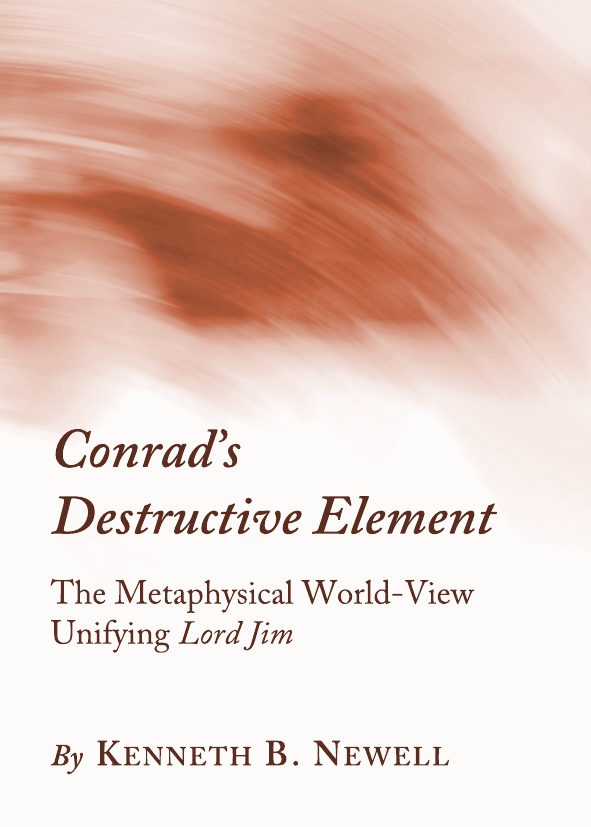
This book presents a new interpretation of Joseph Conrad’s novel Lord Jim based on readings from not only its published text but also its principal manuscript text. Extensive use of the manuscript text has not been a feature of any other work on Lord Jim, and such use helps bring into focus a fixed pattern of meaning and an implicit unity that Conrad said the novel has. This result controverts not only postmodern critics, who say that the novel lacks any fixed pattern of meaning, but almost all critics since its publication, who have said that it lacks unity—specifically, that it separates into two halves, the Patna half and the Patusan half. However, with the help of the manuscript text, a detailed interpretation extending over the whole of Lord Jim shows it to be a unified whole. As Conrad wrote to his publisher four days after completing the novel, it is “the development of one situation, only one really from beginning to end.”
Most recent Lord Jim criticism discusses the novel from a standpoint critical of the author and in political or epistemological terms, whereas the present book discusses it from a standpoint sympathetic to the author and in symbolic and metaphysical terms. The metaphysical question that pervades the novel and helps unify it is whether the “destructive element” that is the “spirit” of the Universe has intention—and, beyond that, malevolent intention—toward any particular individual or is, instead, indiscriminate, impartial, and indifferent. Depending (as a corollary) on the answer to that question is the degree to which the particular individual can be judged responsible for what he does or does not do. Variant responses to the question or its corollary are provided not only by several characters and voices in Lord Jim but also by a letter of Conrad’s and by excerpts from works by Arthur Schopenhauer, Thomas Hardy, James Thomson (“B. V.”), and John Stuart Mill.
The present book is written in a lay vocabulary free of the diction of postmodern theory and so would be understandable to non-academic as well as academic readers. It is intended for anyone interested in gaining a coherent nonpolitical understanding of Lord Jim.