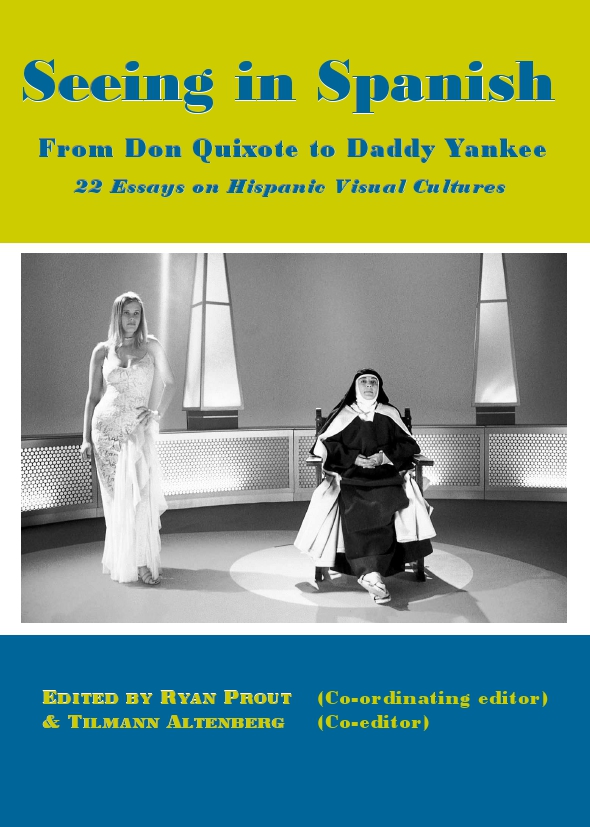
Seeing in Spanish brings together 22 chapters which share a focus on aspects of visual cultures from the Spanish speaking world. Together these chapters address film, photography, cover art, body art, posters, television, architecture, ekphrasis, biography, murals, graffiti, and digital photo-montage. Between Don Quixote and Daddy Yankee, the essays move from the seventeenth century to the present and traverse Europe, the Americas, and cyberspace.
The book is divided into five sections. The first of these, on Spain, includes chapters on the representation of women on LP covers in Spain in the 60s and 70s; portrayals in Spanish cinema of Saint Teresa; Luis Buñuel’s adaptation of Tristana; urban and rural space in recent Spanish documentary film; Catalan television; fine art in Don Quixote; and visions of adoption in three narratives by Spanish writers and filmmakers. The second section, on Mexico and Peru, includes chapters on the fragmentary body in images of Mexico; the art of Abraham Ángel; Jesús Ruiz Durand’s agrarian reform posters; Diego Rivera’s murals; and the role of artistic production in staging the 2006 Oaxaca conflict. The third section, on Cuba, looks at the portrayal of women and of children in recent cinema from the island. It also examines Nancy Morejón’s celebration of the life and art of exiled Cuban artist Ana Mendieta. Section four includes chapters on Chile and Argentina. It addresses street art and graffiti; new forms of publishing; Chilean cinema after Pinochet; and Violeta Parra’s appliqué and collage works. Section five embraces Colombia, Bolivia, and virtual spaces. The contributions to this last section of the book examine childhood in Colombian cinema; the online creativity of pro- and anti-fans of reggaeton; and the photographic diaries of T. Ifor Rees, the UK’s first ambassador to Bolivia. In addition to the geo-political structure which underpins the book’s five sections, the introduction suggests pathways through the contributions focussed on public art and graffiti, women, children, cyberspace and diplomacy, and reconstruction and disintegration.
Seeing in Spanish includes 50 illustrations—stills from films, photographs, reproductions of paintings, and screen grabs from the internet—which complement the chapters’ analyses of aspects of Hispanic visual cultures. To aid accessibility, footnotes throughout the book provide English translations of all references from texts in other languages. Taken together, the book’s 22 chapters make a valuable contribution to the existing literature on figures like Don Quixote and Saint Teresa. They also break new ground in approaches to novel areas of scholarship such as sleeve design, artisanal book production, and digital image manipulation. The book will appeal to students and scholars of Spain and Latin America as well as to a general readership with an interest in the visual cultures of the Spanish speaking world.