
• 0 Items - £0.00
    • No products in the cart.

From £34.99

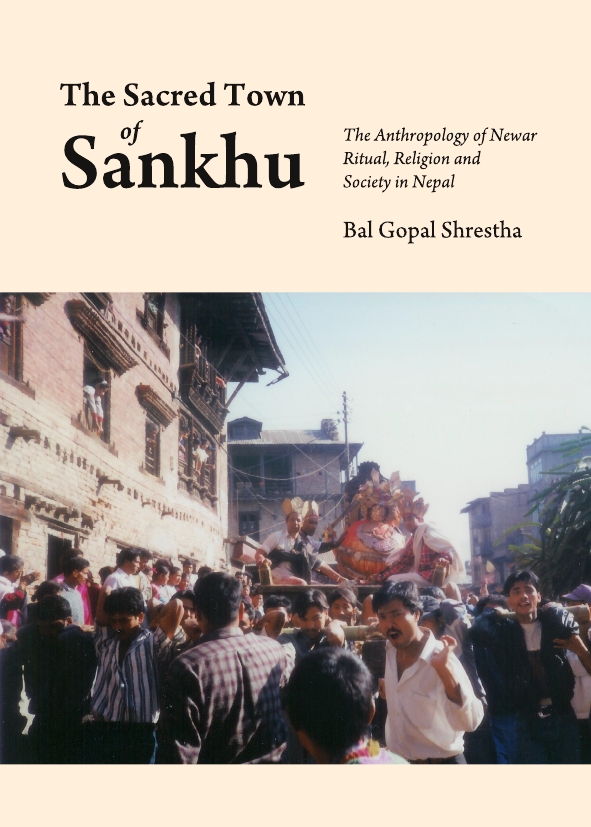
The Sacred Town of Sankhu

The Anthropology of Newar Ritual, Religion and Society in Nepal
By: Bal Gopal Shrestha

From £34.99

This book presents a detailed view of Newar society and culture in the town of Sankhu, Nepal. Founded by the goddess Vajrayoginī, the town is a center for exploring the interplay of Hinduism and Buddhism, castes, and socio-religious life.

This book presents a detailed view of Newar society and culture, and its socio-economic, socio-religious and ritual aspects, concentrating on the Newar town of Sankhu…
From £34.99
From £34.99
Share

This book presents a detailed view of Newar society and culture, and its socio-economic, socio-religious and ritual aspects, concentrating on the Newar town of Sankhu in the Valley of Nepal. The foundation of the town of Sankhu is attributed to the goddess Vajrayoginī, venerated by both Buddhists and Hindus in Nepal and beyond. Myths, history, and topographical details of the town and the sanctuary of the goddess Vajrayoginī and her cult are discussed on the basis of published sources, unpublished chronicles, and inscriptions.

The book deals with the relation between Hinduism and Buddhism, with the interrelations between the Newar castes (jāt), caste-bound associations (sī guthi), and above all with the numerous socio-religious associations (guthi) that uphold ritual life of the Newars. All major and minor Newar feasts, festivals, dances, fasts and processions of gods and goddesses are discussed.

Dr Bal Gopal Shrestha is a Research Fellow at the University of Oxford, UK. He taught Politics of South and Southeast Asia at the University of Leiden (2006–07). He made the award-winning ethnographic documentary Sacrifice of Serpents: The Festival of Indrayani, Kathmandu 1992/94 (Leiden, 1997) together with the late Bert van den Hoek and Dirk J. Nijland. He has conducted fieldwork in Nepal, India, the UK and Belgium, and has published widely on Nepalese religious rituals, Hinduism, Buddhism, ethnic nationalism, the Maoist movement, and political development in Nepal.

Hardback

  • ISBN: 1-4438-3770-9
  • ISBN13: 978-1-4438-3770-5
  • Date of Publication: 2012-05-15

Paperback

  • ISBN: 1-4438-4910-3
  • ISBN13: 978-1-4438-4910-4
  • Date of Publication: 2013-08-07

Ebook

  • ISBN: 1-4438-3825-X
  • ISBN13: 978-1-4438-3825-2
  • Date of Publication: 2013-08-07

Subject Codes:

  • BIC: HBTB, HRGC, JHMC
  • BISAC: SOC002010, SOC039000, SOC005000, REL029000, REL017000, REL032020
  • THEMA: ATF, ATJ, QRD
635
  • Historical ethnographies of entire towns are among the most challenging scholarly endeavors. The sheer number of people, the broad geographical spaces, and the inherent institutional and cultural complexities of urban life require inordinate amounts of research time and interpretative commitment. [...] The Sacred Town of Sankhu provides a sound and holistic ethnographic treatment of a key center of Newar civilization. In a field in which sociocultural documentation has become less important than theory, Shrestha provides a wealth of painstakingly gathered data on which scholars can fruitfully build their understanding of Newar civilization.
    - – Todd T. Lewis College of the Holy Cross; The Historian, 78: 3 (2016)
  • The Sacred Town of Sankhu ... makes a significant contribution to the study of Nepal's Newars with an updated examination of Newar life and culture... It brings together a wealth of data for scholars who are looking for specific information about different aspects of Newar society, culture, rituals, and festivals, and is particularly of interest for the attention paid to Hindu Newars, who now constitute the majority in Sankhu. Furthermore, this detailed account of Sankhu as a sacred town is a valuable resource that documents the constitution and workings of this ancient town in the modern period.
    - – Jessica Vantine Birkenholtz University of Illinois, Urbana-Champaign; Himalaya, the Journal of the Association for Nepal and Himalayan Studies, 34:2 (2014)
  • This book, started in 2002 as a PhD thesis at Leiden University, has grown into a voluminous treasure of field data covering history, mythology, ritual geography, caste and religion, guthi organisation and socio-economy – all treated in an anthropological framework. It is this holistic approach (reflecting the best traditions of the Leiden school of cultural anthropology) that determines the book's value, and reference to it should henceforward not be lacking in any serious publication, in whatever discipline, on Newar culture.
    - – Sjoerd Zanen International Institute for Asian Studies Newsletter, 64 (Summer 2013)
  • Bal Gopal Shrestha's rigorously researched work on Sankhu is an invaluable anthropological contribution to Nepali and South Asian studies, and I wholeheartedly recommend that libraries specialising in these subject areas hold copies of it.
    - – Ajaya Mali The Kathmandu Post, 19 January 2013
  • We have this unique, rich, marvelously complete and balanced book . . . This book is the first complete systematic description of the religious year of any town in Nepal, and it may well serve as an example for more similar studies.
    - – Dr D. H. A. Kolff Professor of South Asian History, Emeritus, University of Leiden, The Netherlands
  • It is a very valuable book, full of very interesting ethnographic data, based on a long fieldwork in this Newar town located in the Valley of Kathmandu, Nepal. This piece of work is in my opinion one of the best theses submitted by a Nepalese student in anthropology in Europe these last decades.
    - – Prof Dr Gérard Toffin Director of Research, CNRS, France
  • The whole history and culture of the town of Sankhu are covered with encyclopedic thoroughness, detail, and local knowledge. The book will be an indispensable reference for all those who study the Newars and who are interested in the social organization, culture, and history of the Kathmandu Valley.
    - – Prof Dr David N. Gellner University of Oxford, UK
  • The book is a perceptive ethnography of Sankhu focused on its social structure, religion and culture, lately in the throes of change. Dr Shrestha has done extensive fieldwork to collect data, which are supplemented by a close and critical assessment of available textual material relating to the local myths, legends and historical traditions. This book is exemplary ethnography of the social, cultural and religious practices of the Newars written by an insider who is a promising scholar well-versed in the social sciences.
    - – Dr Kamal P. Malla Professor of English, Emeritus, Tribhuvan University, Nepal

Meet The Author

Processing Your Order

Please wait while we securely process your order.
Do not refresh or leave this page.
You will be redirected shortly to a confirmation page with your order number.