• 0 Items - £0.00
    • No products in the cart.

£39.99

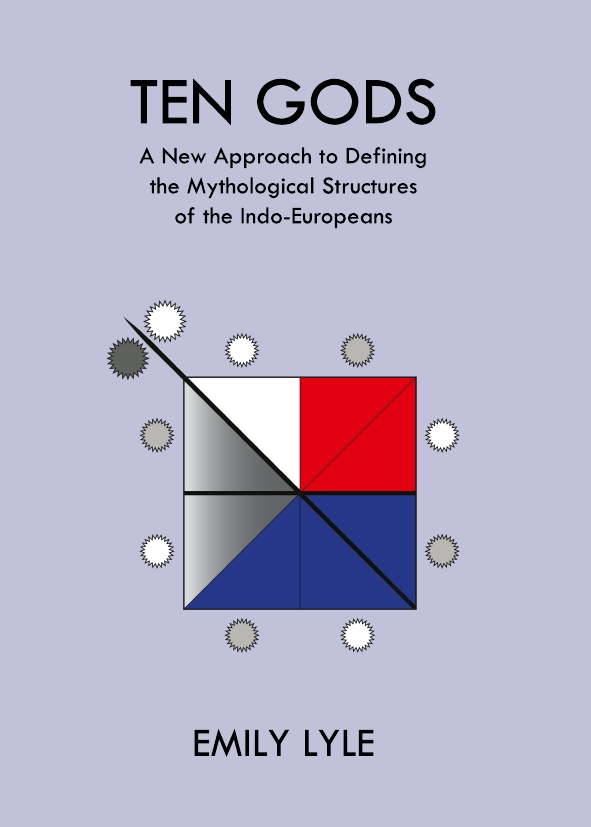
Ten Gods

A New Approach to Defining the Mythological Structures of the Indo-Europeans
By: Emily Lyle

£39.99

This book uncovers the shared origins of Indo-European gods, proposing a pantheon of ten deities who reflect the social organization of their prehistoric society. Analyzing sources like the Edda and Rāmāyaṇa, it reveals Europe's original culture.

The various Indo-European branches had a shared linguistic and cultural origin in prehistory, and this book sets out to overcome the difficulties about understanding the…
£39.99
£39.99
Share

The various Indo-European branches had a shared linguistic and cultural origin in prehistory, and this book sets out to overcome the difficulties about understanding the gods who were inherited by the later literate cultures from this early “silent” period by modelling the kind of society where the gods could have come into existence. It presents the theory that there were ten gods, who are conceived of as reflecting the actual human organization of the originating time.

There are clues in the surviving written records which reveal a society that had its basis in the three concepts of the sacred, physical force, and fertility (as argued earlier by the French scholar, Georges Dumézil). These concepts are now seen as corresponding to the old men, young men, and mature men of an age-grade system, and each of the three concepts and life stages is seen to relate to an old and a young god. In addition to these six gods, and to two kings who relate in positive and negative ways to the totality, there is a primal goddess who has a daughter as well as sons. The gods, like the humans of the posited prehistoric society, are seen as forming a four-generation set originating in an ancestress, and the theogony is explored through stories found in the Germanic, Celtic, Indian, and Greek contexts.

The sources are often familiar ones, such as the Edda, the Mabinogi, Hesiod’s Theogony, and the Rāmāyaṇa, but selected components are looked at from a fresh angle and, taken together with less familiar and sometimes fragmentary materials, yield fresh perspectives which allow us to place the Indo-European cosmology as one of the world’s indigenous religions. We can also gain a much livelier sense of the original culture of Europe before it was overlaid by influences from the Near East in the period of literacy. The gods themselves continue to exert their fascination, and are shown to reflect a balance between the genders, between the living and the ancestors, and between peaceful and warlike aspects expressed at the human level in alternate succession to the kingship.

Emily Lyle is a Senior Research Fellow in the Department of Celtic and Scottish Studies at the University of Edinburgh and has been engaged in exploring custom and belief, mythology and folk narratives, and ballads and songs, at this university since 1970. Her many publications include Archaic Cosmos: Polarity, Space and Time (Edinburgh: Polygon, 1990) and Fairies and Folk: Approaches to the Scottish Ballad Tradition (WVT Wissenschaftlicher Verlag Trier, 2007). She is President of the Traditional Cosmology Society and the Ritual Year Working Group of SIEF (Société Internationale d’Ethnologie et de Folklore) and is a Director of the International Association for Comparative Mythology. She received an MA (Hons) from the University of St Andrews in 1954 and a PhD from the University of Leeds in 1967, and has held Fellowships at the Radcliffe (later Bunting) Institute and the Center for the Study of World Religions at Harvard University; the Institute for Advanced Studies in the Humanities at the University of Edinburgh; and the Humanities Research Centre at the Australian National University.

Hardback

  • ISBN: 1-4438-4156-0
  • ISBN13: 978-1-4438-4156-6
  • Date of Publication: 2012-12-03

Ebook

  • ISBN: 1-4438-4455-1
  • ISBN13: 978-1-4438-4455-0
  • Date of Publication: 2012-12-03

Subject Codes:

  • BIC: HRKP, JFHF, JHMC
  • THEMA: QRRT1, QRSV, QRS
155
  • "Ten Gods is a stimulating work that draws together Emily Lyle’s approach to Indo-European cosmology. [...] This work offers new perspectives on early Indo-European culture and the later cultures through which it is reflected, as well as challenging some conventional views with the perspectives it develops. This work has potential for a wide appeal to scholars and students interested in cultural memory, comparative studies and ways of looking at emergent patterns in culture that may be realized across a wide range of forms and contexts."
    - Etunimetön Frog Post-doctoral researcher, Department of Folklore Studies, University of Helsinki
  • "Lyle’s reconstruction of structure, her effort to locate ‘the grammar of narrative in relation to cosmology’ (121) and to explore ‘a well-crafted cosmology operating in terms of ten gods’ (122) is unfailingly well documented and stimulating. Her objective is to bring the perhaps reluctant reader to see the merits of her method and the archaic tenfold grid, rather than to win conviction for her interpretation of any single myth. In this she succeeds admirably."
    - William Sayers Cornell University
  • "Ten Gods offers a new perspective on the exploration of Indo-European culture and will be of interest to anyone interested in topics such as collective memory and comparative mythology, as well as for readers who want to gain insights into a new way of exploring collective ideas in pre-writing societies."
    - Anja Mlakar Studia mythologica Slavica 20 (2017)

Meet The Author