• 0 Items - £0.00
    • No products in the cart.

£39.99

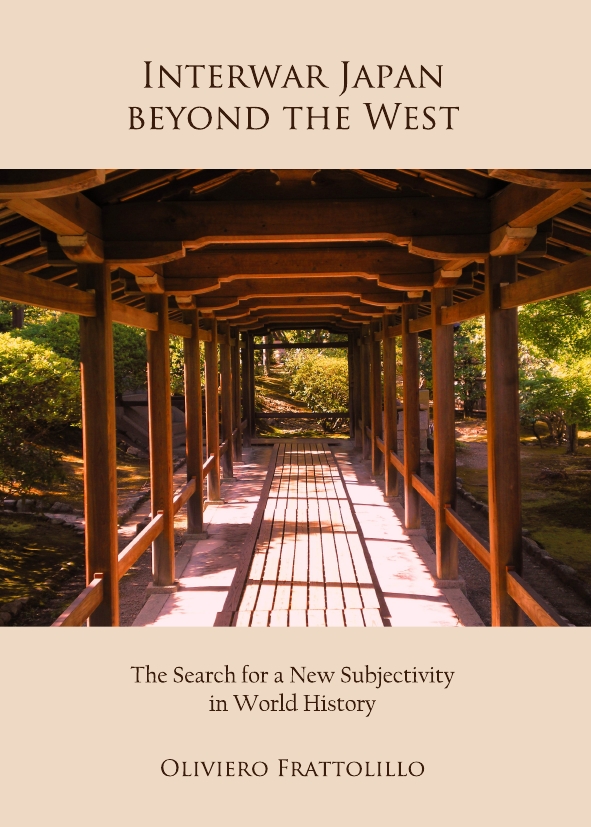
Interwar Japan beyond the West

The Search for a New Subjectivity in World History
By: Oliviero Frattolilio

£39.99

To avoid the Western imperialist yoke, late nineteenth-century Japan embraced an imperial identity. This was justified by a philosophy that saw Japan’s hegemonic aspirations as a moral obligation: a duty to overcome modern civilization and promote a new culture.

In the late nineteenth century, Japan was the only non-Western country to have successfully faced the challenges of Westernization. At the end of the Meiji…
£39.99
£39.99
1-4438-4230-3 , , ,
Share

In the late nineteenth century, Japan was the only non-Western country to have successfully faced the challenges of Westernization. At the end of the Meiji Era, just three decades after the end of the country’s feudal age, it became Great Britain’s ally, while its soldiers were deployed in Beijing, operating alongside the great European powers. Meanwhile, in Japan, the perception of a scientifically and technologically advanced West came to be imbued by negative connotations, generated by the threatening Western presence in Asia. In order to avoid succumbing to the European imperialist yoke, Japan has itself gradually converted its international status by embracing an imperialistic identity.

The new image of the world responding to the current historical situation could only result from a philosophy immersed in historicity, far from its metaphysical dimension. In a philosophy mediated by history, self-awareness would have coincided with the “historical manifestations of history”. Based on these premises, the Chūōkōron group seemed to have presented Japan’s hegemonic aspirations as an expression of its “real historical manifestation”. This sounded like an explicit declaration of ideologically supporting the country’s involvement in the war. But what is the meaning that the participants in the debates attributed to the idea of Japan’s “real historical manifestation”? The answer lies in a moral obligation that the country saw as “the duty” of world history: overcoming modern civilization while promoting a new culture.

Oliviero Frattolillo is a Lecturer at the University of Napoli “L’Orientale” where he teaches Political and Diplomatic History of East Asia, and History of International Relations of Asia and Africa. His research interests since 1999 have focused on modern and contemporary Japanese history, Japan’s intellectual history and the history of international relations.

He received his PhD in Asian Studies in 2004 from the University of Napoli “L’Orientale”. In 2005, he was Visiting Researcher at the Okinawa University of Arts, and since 2012, he has been Visiting Scholar Fellow at the Nanzan Institute for Religion and Culture (Nagoya University) and Visiting Researcher at the School of International Politics and Economics (Aoyama Gakuin University, Tokyo). He is a member of the editorial board of several international journals and member of various international scientific associations.

His works include Diplomacy in Japan-EU Relations: From the Cold War to the Post-Bipolar Era (London-New York: Routledge, 2013; forthcoming); “Itaria koji junrei. Bi to shisō no henreki” in Gengo bunka kenkyū, 20/2 (Kyoto: Ritsumeikan University, 2008); Il Giappone e l’Occidente, dalla rivolta culturale al dibattito sul “superamento della modernità” (Napoli: L’Orientale editrice, 2006); Watsuji T., Pellegrinaggio alle antiche chiese d’Italia (Palermo: L’EPOS, 2005; a translation from Japanese).

Hardback

  • ISBN: 1-4438-4230-3
  • ISBN13: 978-1-4438-4230-3
  • Date of Publication: 2013-01-17

Ebook

  • ISBN: 1-4438-6511-7
  • ISBN13: 978-1-4438-6511-1
  • Date of Publication: 2013-01-17
145

Subject Codes:

  • BIC: HBJF, HBWQ, HPDF
  • THEMA: NHF(3MPBLB), NHWR7, NHWL
145

Meet The Author