• 0 Items - £0.00
    • No products in the cart.

£39.99

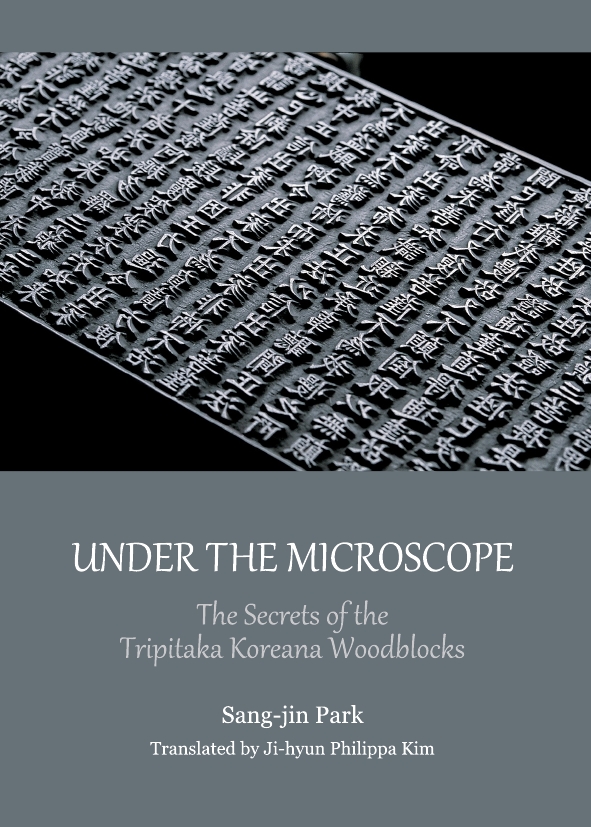
Under the Microscope

The Secrets of the Tripitaka Koreana Woodblocks
By: Ji-hyun Philippa Kim, Sang-jin Park

£39.99

A wood anatomist’s study of the Tripitaka Koreana looks to physical evidence—the woodblocks themselves—for answers. The findings challenge so-called facts and offer insights into the creation, material, and miraculous conservation of this 13th-century artifact.

This volume presents a wood anatomist’s study of the Tripitaka Koreana, the world’s oldest surviving printing artifact from 13th-century Korea. Whereas existing research on this…
£39.99
£39.99
Share

This volume presents a wood anatomist’s study of the Tripitaka Koreana, the world’s oldest surviving printing artifact from 13th-century Korea. Whereas existing research on this most comprehensive and accurate version of the Buddhist canon in East Asia has relied primarily on incomplete textual evidence and on less than reliable oral traditions in addressing the secrets of the creation, birthplace, material, and miraculous conservation of the Tripitaka Koreana, the author of this volume looks to physical evidence – the woodblocks themselves – for answers.

The 81,258 printing plates reveal a wealth of information under the microscope of a wood anatomist: the microscopic picture that emerges helps identify the particular wood species, leading us to their natural habitat, and in turn to the likely logging and engraving sites. These findings challenge the so-called facts about the woodblocks, and offer valuable insights into the day-to-day creation process, from the preparation to the engraving phase, as well as post-production care for optimal preservation. Its value as a Buddhist text aside, the Tripitaka Koreana is an avatar of old Korean science that compels us to go one step further than reading between the lines; that is, to look beneath the engraved letters for clues left behind by nature, man, and time.

Sang-jin Park (author) received his doctorate from Kyoto University and is a Professor Emeritus of Forest Engineering at Kyungpook National University. He has published numerous books in Korean, including The Trees Populating the Royal Palaces of Korea (2001), A Millennium’s Survival Log (2004), History as Engraved on Wood (2004), Cultural Landmarks of Korea: A Tree-Watcher’s Notes (2007), The World of Korean Trees in Culture and History I, II (2011).

Ji-hyun Philippa Kim (translator) received her doctorate from Harvard University and taught at Syracuse University (2006–2008) and the City University of New York (2008–2011). Her research interests include medieval French literature, 19th-century medievalism, the history of books and the history of thought.

Hardback

  • ISBN: 1-4438-4608-2
  • ISBN13: 978-1-4438-4608-0
  • Date of Publication: 2013-05-03

Ebook

  • ISBN: 1-4438-6732-2
  • ISBN13: 978-1-4438-6732-0
  • Date of Publication: 2013-05-03

Subject Codes:

  • BIC: GT, HRES, PST
  • BISAC: HIS023000, HIS016000, HIS054000, SCI034000, SCI011000, SCI047000
  • THEMA: GT, QRFF, PST
175
  • Professor Park has used the lens of botany, specifically the science concerned with wood, to make a study of a major artifact of early print technology. Through the results of his research, we now have sufficient information to construct a defensible theory about the history of the 13th-century wooden plates that contain a version of the Chinese Buddhist texts used as a standard by international scholars. Professor Park has masterfully shown us that the physical objects are a necessary component for our study of these religious writings. He revises many long held theories and in doing so opens up a new way of dealing with one of the National Treasures of Korea.
    - – Lewis Lancaster Professor Emeritus, University of California, Berkeley
  • Thanks to Professor Sang-jin Park's research, the world-famous Tripitaka Koreana is no longer a silent witness. His meticulous analysis of how the wooden printing blocks were made sheds new light on 13th-century Korea: it reveals which trees were used and where they came from, how the wood was prepared and carved, and what kind of effort, technology, manpower, and piety it took to make them. His book offers both an accessible and revisionist account of the history and significance of the Tripitaka Koreana. His lucid overview of the printing blocks' history will inspire anyone who wishes to know more about this remarkable feat of printing technology, while the results of his scientific analysis will force other researchers of the Tripitaka to reinterpret written records that have too often been used uncritically.
    - – Sem Vermeersch Professor, Seoul National University ''For a European reader, this book is not only interesting for its rich historical and wood scientific detail. It is humbling to read how early the printing process had been perfected around the 7th and 8th centuries AD in the East when in Europe we still had to wait for ages for the (re-)invention of the printing press. This book reports on an important phase of the wood culture in Asia. It is fully underpinned by wood anatomical evidence and common biological sense. Warmly recommended.'' - Pieter Baas, IAWA Journal 34:3 (2013), 324.

Meet The Author

Processing Your Order

Please wait while we securely process your order.
Do not refresh or leave this page.
You will be redirected shortly to a confirmation page with your order number.