• 0 Items - £0.00
    • No products in the cart.

£44.99

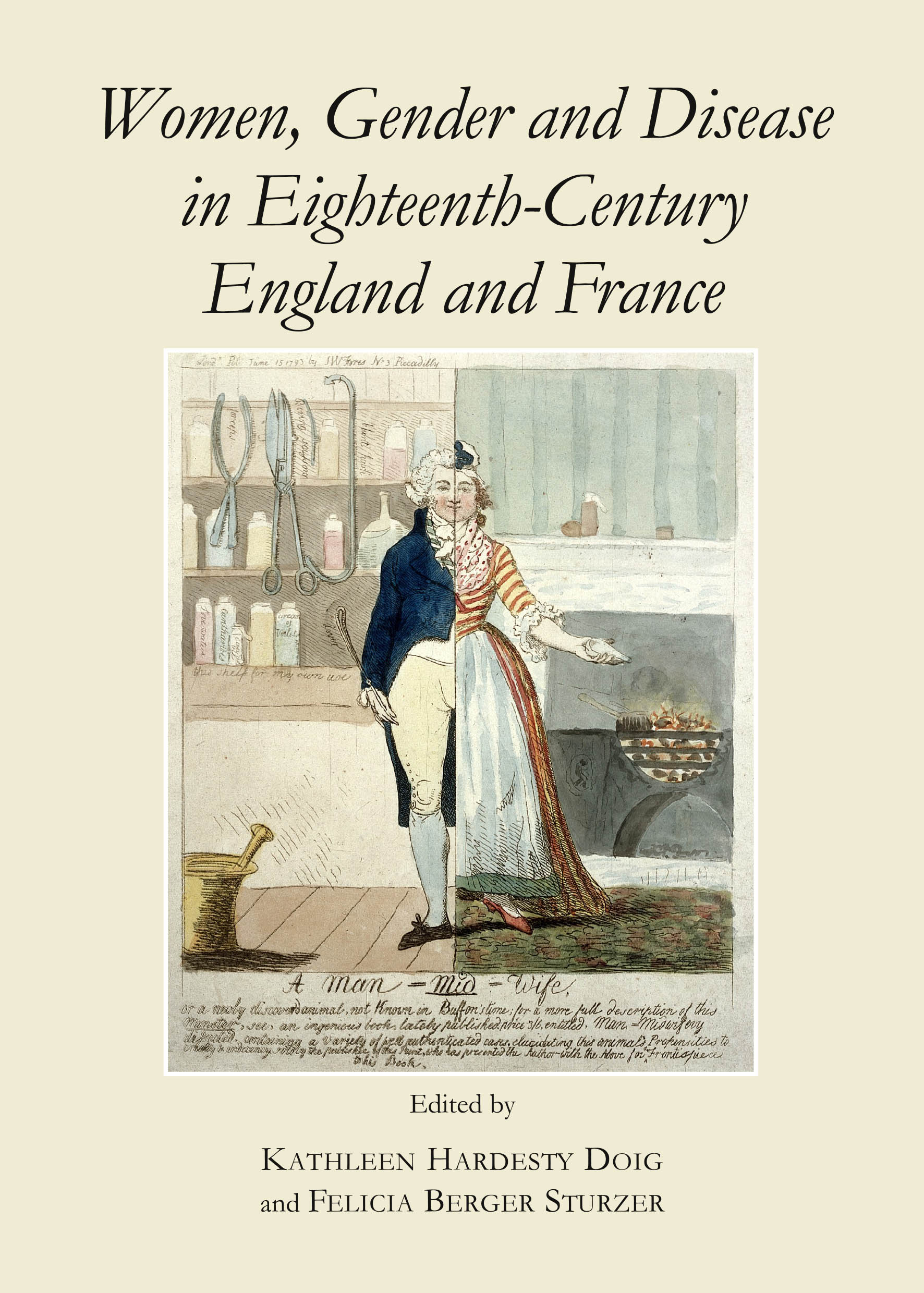
Women, Gender and Disease in Eighteenth-Century England and France

Edited By: Ann Kathleen Doig, Felicia B. Sturzer

£44.99

These essays explore women, gender, and disease in 18th-century England and France. Excluded from universities, women nonetheless contributed to anatomy, botany, and medicine, informing literary texts and raising questions about their role in the Enlightenment.

Based on encyclopedias, medical journals, historical, and literary sources, this collection of interdisciplinary essays focuses on the intersection of women, gender, and disease in England…
£44.99
£44.99
Share

Based on encyclopedias, medical journals, historical, and literary sources, this collection of interdisciplinary essays focuses on the intersection of women, gender, and disease in England and France. Diverse critical perspectives highlight contributions women made to the scientific and medical communities of the eighteenth century. In spite of obstacles encountered in spaces dominated by men, women became midwives, and wrote self-help manuals on women’s health, hygiene, and domestic economy. Excluded from universities, they nevertheless contributed significantly to such fields as anatomy, botany, medicine, and public health.

Enlightenment perspectives on the nature of the female body, childbirth, diseases specific to women, “gender,” sex, “masculinity” and “femininity,” adolescence, and sexual differentiation inform close readings of English and French literary texts. Treatises by Montpellier vitalists influenced intellectuals and physicians such as Nicolas Chambon, Pierre Cabanis, Jacques-Louis Moreau de la Sarthe, Jules-Joseph Virey, and Théophile de Bordeu. They impacted the exchange of letters and production of literary works by Julie de Lespinasse, Françoise de Graffigny, Nicolas Chamfort, Mary Astell, Frances Burney, Lawrence Sterne, Eliza Haywood, and Daniel Defoe.

In our post-modern era, these essays raise important questions regarding women as subjects, objects, and readers of the philosophical, medical, and historical discourses that framed the project of enlightenment.

Kathleen Hardesty Doig is Professor of French in the Department of Modern and Classical Languages at Georgia State University. She has published mainly on encyclopedism, including The Encyclopédie méthodique: Expansion and Revision (SVEC 2013). With the late Dorothy M. Medlin, she edited André Morellet’s Mémoires sur le XVIIIe siècle et sur la Révolution. She is on the editorial board of New Perspectives on the Eighteenth Century.

Felicia Berger Sturzer was Professor of French and Head of the Department of Modern and Classical Languages and Literatures at the University of Tennessee at Chattanooga until her retirement in 2013. Her research focuses on women’s literature, the epistolary novel, Enlightenment sociability, and cultural studies. She has published mainly on Marie Jeanne Riccoboni, Julie de Lespinasse, and Pierre Carlet de Marivaux. She serves on the editorial boards of New Perspectives on the Eighteenth Century and Women in French Studies.

Hardback

  • ISBN: 1-4438-5551-0
  • ISBN13: 978-1-4438-5551-8
  • Date of Publication: 2014-04-01

Ebook

  • ISBN: 1-4438-6121-9
  • ISBN13: 978-1-4438-6121-2
  • Date of Publication: 2014-04-01

Subject Codes:

  • BIC: JFSJ1, MBX, PDX
  • BISAC: LIT024030, LIT003000, LIT025050, HIS058000, HIS037050, HIS054000
  • THEMA: JBSF1, MBX, PDX
265
  • Following a comprehensive introduction ... ten chapters written by both established scholars and relative newcomers in disciplines ranging from French and English to history and gender studies present compelling evidence drawn from sources as diverse as medical treatises, literary texts, personal narratives, and encyclopedias. This volume persuades and impresses through the broad range of the scholars' expertise, the great variety in their source materials as well as their careful documentation and annotation. [...] It offers very useful contextualization for Enlightenment discourses on women, gender and disease, and at its nexus identifies and reclaims women's contributions to medicine and science, thus allowing readers to further fill the relative void of knowledge on women in traditionally male-dominated fields governing life and death.
    - —Professor Marijn S. Kaplan University of North Texas; New Perspectives on the Eighteenth Century, 13: 1 (2016)
  • This anthology fills a gap in the history of women, medicine and disease. While there has been some scholarly work done on the connection of these topics in seventeenth-century England, less has been produced for the eighteenth and early nineteenth century that also includes developments in France. I particularly like the mixing of these national transformations in the three organizational categories crafted by the editors: the natural history of women, women as medical agents, and the gendering of disease.
    - —Elizabeth Lane Furdell University of North Florida
  • A grand exploration of the medical issues facing women in the long eighteenth century as seen through medical treatises and contemporary literary works. The broad range of topics covered in the essays informs and illuminates both general medical history as well as women's studies.
    - —Elaine Breslaw Ph.D., author of 'Lotions, Potions, Pills, and Magic: Health Care in Early America'.
  • Having just read the manuscript of Women, Gender and Disease in Eighteenth-Century England and France, I feel that my knowledge of eighteenth-century life and culture has increased exponentially. Although the title focuses on gender and disease, the actual essays delve into a much broader range of subjects than those suggested in the title. They include, among others, the education and training of doctors, nurses, pharmacists and various officiers de santé, for both women and men; in addition to the rules, regulations, politics, and laws governing these professions. Speaking of disease, entails, naturally, a discussion of life, and, for women, various stages of life-giving: conception, contraception, pregnancy, abortion, birth, infant caring, and sexuality in general, including venereal disease.
    - —Samia I. Spencer Professor Emerita of French, Former Honorary Consul of France in Alabama

Processing Your Order

Please wait while we securely process your order.
Do not refresh or leave this page.
You will be redirected shortly to a confirmation page with your order number.