• 0 Items - £0.00
    • No products in the cart.

£44.99

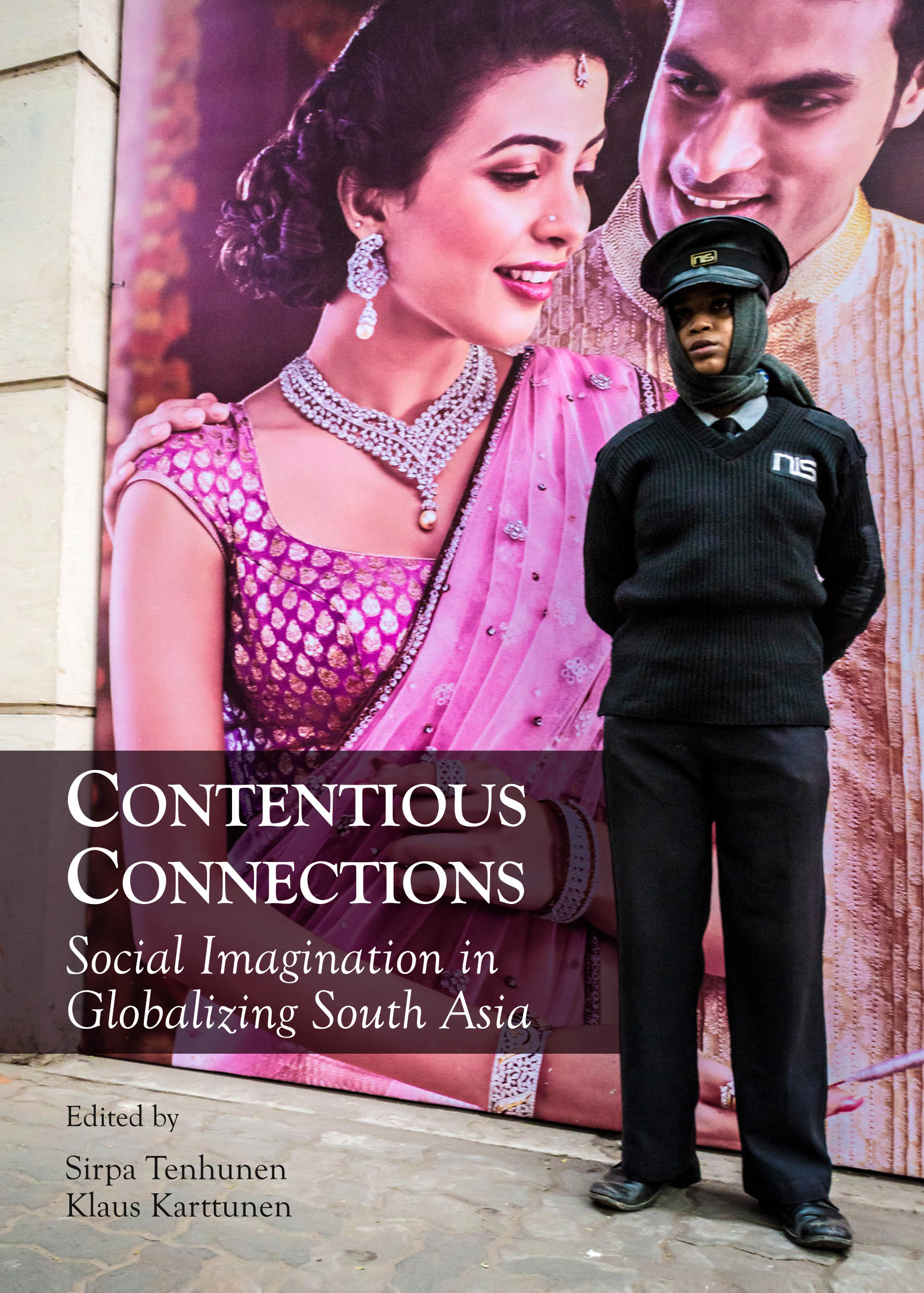
Contentious Connections

Social Imagination in Globalizing South Asia
Edited By: Klaus Karttunen, Sirpa Tenhunen

£44.99

This multidisciplinary volume analyzes how transnational connections are re-imagining politics, gender, and public culture in South Asia. It explores the relationship between local worlds and global flows, questioning the role of power, the state, and agency.

Combining history, cultural studies, sociology, international politics, and anthropology, this multidisciplinary volume analyzes transnational connections in India and South Asia. The articles explore how politics,…
£44.99
£44.99
, 1-4438-5648-7 , , ,
Share

Combining history, cultural studies, sociology, international politics, and anthropology, this multidisciplinary volume analyzes transnational connections in India and South Asia. The articles explore how politics, gender, religious discourses, regional concepts, and public culture are being re-imagined amidst translocal connections. In theoretical terms, the volume contributes to understandings of the relationship between culture, globalization and social imagination by posing following questions: What is the nature of relationships between local worlds and global flows both historically and in contemporary South Asia? What role does the state play amidst global flows? How do power issues and local hierarchies contribute to social imaginaries? And how do translocal flows influence opportunities for individual agency? The volume introduces articles dealing with various aspects and arenas of globalization in South Asia: the economy and the media landscape in India (Derné); cinema (Kumar); global brands (Majumder); religious music and South Asian Islam (Viitamäki); foreign politics (Grekova-Stefanova); politics and gender (Roy); political uses of mobile telephony (Tenhunen); Indian diaspora (Svensson); migration in colonial India (Adapa); and the position of history in classical India (Karttunen).

Sirpa Tenhunen is a Researcher and the Director of the Nordic Centre in India. In addition to new media, her research interests cover gender, work and politics in India. Her recent books include Introduction to India: Culture, Politics and Development and Means of Awakening: Gender, Politics and Practice in Rural India.

Klaus Karttunen served as the Professor of South Asian and Indoeuropean Studies at the University of Helsinki from 2006 to 2012. He has published a number of studies about Indian history and culture, Sanskrit philology, India in Greek and Roman literature, and the history of Asian studies.

Satyanarayana Adapa, Steve Derné, Zornitza Grekova-Stefanova, Rajesh Kumar, Auritro Majumder, Dayabati Roy, Christian Franklin Svensson, Mikko Viitamäki, Klaus Karttunen

Hardback

  • ISBN: 1-4438-5648-7
  • ISBN13: 978-1-4438-5648-5
  • Date of Publication: 2014-04-14

Ebook

  • ISBN: 1-4438-5834-X
  • ISBN13: 978-1-4438-5834-2
  • Date of Publication: 2014-04-14

Subject Codes:

  • BIC: JFFS, JH, J
  • THEMA: GTQ, JH, J
220
  • "Recent South Asian scholarship has repeatedly demonstrated how the historical experience of modernity is distinctive in South Asia—quite different from the European modality. Certainly there are similarities across global regions in the constellation of processes constitutive of contemporary globalization: more integrated media infrastructures, a large mobile transnational classes of elite cosmopolitans and migrant workers, the infusion of corporate capital into arenas previously under the aegis of the state…the list is formidable. And yet these “flows” or “forces” are heterogeneouslyencountered in different global regions. The volume’s focus on “the social imagination” provides a bold and capacious rubric for thinking about how the historical difference of globalization is lived in South Asia. The social imagination ranges from the micro-unit of the individual subject to macroscalar social groups; it is the practice of world making that is always attentive to the specific materiality of local contexts. The essays theorize the different forms that the social imagination takes in globalizing South Asia, and, in doing so, reinstates modernity as a constantly negotiated, even contested, experience. The volume is carefully conceived in including heterogeneous local contexts
    - and is robust and wide-ranging in its critical reach." - Bishnupriya Ghosh, Department of English, UC Santa Barbara