• 0 Items - £0.00
    • No products in the cart.

£47.99

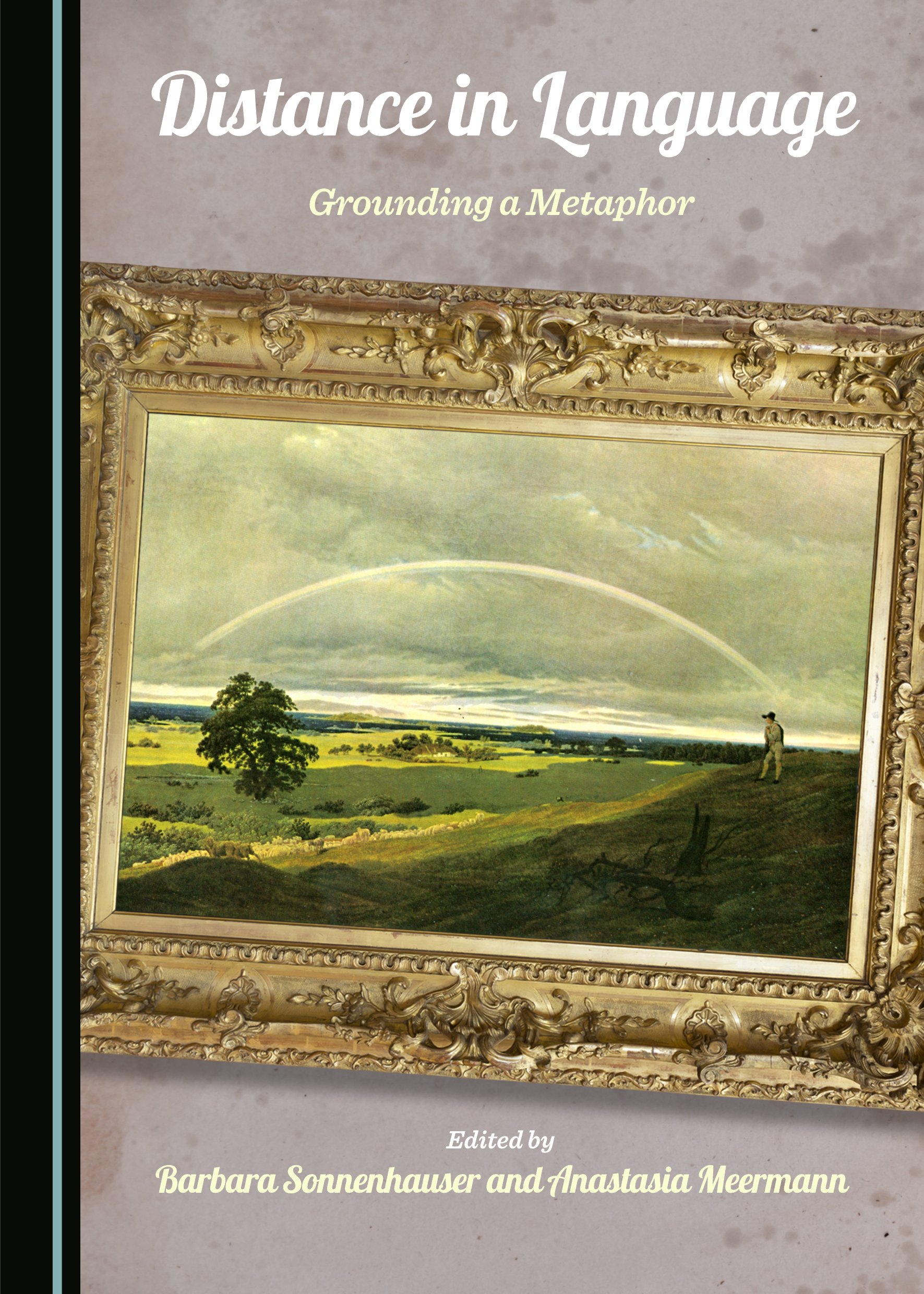
Distance in Language

Grounding a Metaphor
Edited By: Anastasia Meermann, Barbara Sonnenhauser

£47.99

The metaphor of “distance” is crucial for understanding space, time, and relationships, but its use in linguistics is inconsistent. This volume grounds the concept, exploring its potential for analyzing the semantics, grammar, and discourse of various languages.

The conceptual metaphor of “distance” plays a crucial role in current perceptions of the world and humans’ various interactions within it. It hardly seems possible…
£47.99
£47.99
Share

The conceptual metaphor of “distance” plays a crucial role in current perceptions of the world and humans’ various interactions within it. It hardly seems possible to conceptualize space and time, emotional involvement in events, and relationships with other people in terms other than “distance”. As a consequence, this primarily spatial concept figures prominently in the verbal expression of these abstract notions, and is thus highly relevant for the analysis of linguistic phenomena. In recent decades, “distance” has been employed as a fruitful tool in different, primarily cognitive and functional, approaches. However, the explanatory power of this notion suffers from certain inconsistencies: On the one hand, very different linguistic phenomena are described in terms of “distance”, while, on the other, the notion itself relates to disparate concepts.

By providing a thorough grounding of the metaphor of distance, the present volume makes this notion tangible and thus applicable in various domains of linguistic analysis. The contributions gathered in this volume provide a concise delimitation from neighbouring concepts, and explore the rich potential of this metaphor for the analysis of the semantics, usage conditions and discourse-pragmatic effects of both morpho-syntactic categories and syntactic structures. They also investigate the role of “distance” in understanding mechanisms of linguistic interaction. The languages covered in this volume include, amongst others, languages from the Germanic, Romance and Slavic families, as well as Japanese and Turkish.

Barbara Sonnenhauser is Professor of Slavic Linguistics at the University of Zurich. Her research interests include verbal categories, synchronic and diachronic aspects of South Slavic syntax, and the interaction of semantics and (discourse-)pragmatics, as well as various questions in the fields of general linguistics and linguistic semiotics. She has most recently been concerned with perspectival phenomena, discourse structure and narrativity.

Anastasia Meermann is a PhD candidate and Research Assistant at the Institute for Slavic Studies at the LMU Munich. Her research interests include questions concerning syllable structures, as well as issues in Balkan linguistics. In her PhD dissertation, she focuses on the semantics and pragmatic functions of the Serbian tense system, particularly as concerns the effects of auxiliary variation.

Evangelia Adamou, Eleni Buzarovska, Grace Fielder, Marija Kusevska, Maxim Makartsev, Anastasia Meerman, Imke Mendoza, Liljana Mitkovska, Yoshinori Nishijima, Galina Putjata, Sonja Zeman

Hardback

  • ISBN: 1-4438-7261-X
  • ISBN13: 978-1-4438-7261-4
  • Date of Publication: 2015-04-10

Ebook

  • ISBN: 1-4438-7884-7
  • ISBN13: 978-1-4438-7884-5
  • Date of Publication: 2015-04-10

Subject Codes:

  • BIC: CFG, CFK, CFB
  • BISAC: LAN009000, LAN016000, LAN009030, LAN009060, LAN009010, LAN009020
  • THEMA: CFG, CFK, CFB
297