
• 0 Items - £0.00
    • No products in the cart.

£47.99

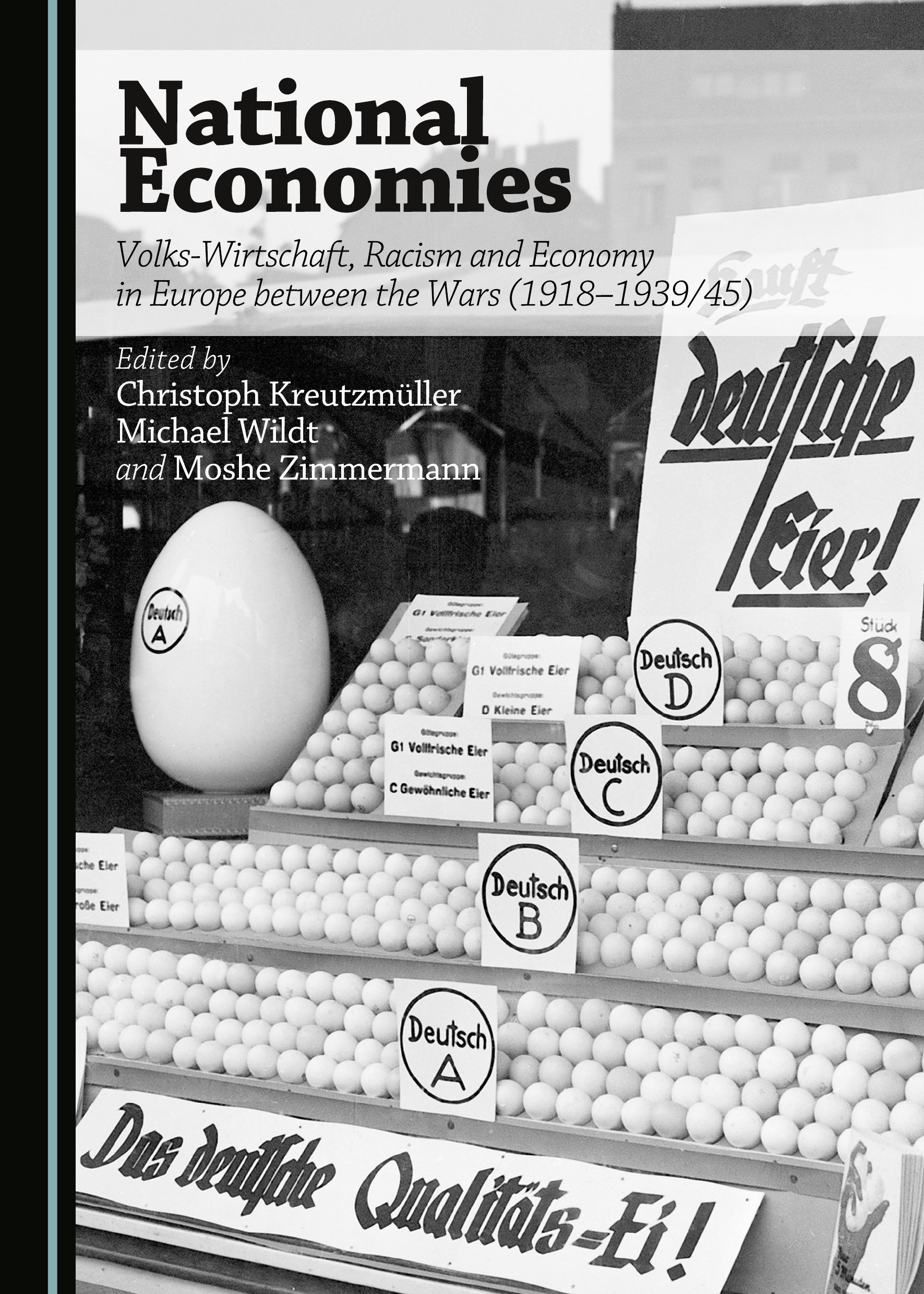
National Economies

Volks-Wirtschaft, Racism and Economy in Europe between the Wars (1918-1939/45)
Edited By: Christoph Kreutzmueller, Michael Wildt, Moshe Zimmermann

£47.99

After WWI, the collapse of the global economic system led to racist cleansing and mass murder. This book explores the fault-lines that deepened in European economies, asking: who decided who was to be excluded, and where did the boundaries lie?

This is a book about economics and racism: During World War I, the liberal global economic system, based on principles of free trade and most-favored…
£47.99
£47.99
Share

This is a book about economics and racism: During World War I, the liberal global economic system, based on principles of free trade and most-favored nation treatment and negotiated in gold parities, collapsed for good. The disintegration and collapse of commerce eventually led to racist cleansing, expulsion and mass murder. Against this background, this book offers new perspectives on the racist fault-lines that appeared and deepened in European economies after the end of what was regarded as the Great War.

At what point did people start to ostracize their neighbors economically because they thought they were of a different ethnic group? Who decided who was to be excluded? Where did the fault-lines open? Where did the boundaries lie? How were they defined – by law, or by common practice? How much extra time and money were people prepared to spend in order to do ostracize their neighbors? And what did that mean for the economy – and society – as such?

Christoph Kreutzmueller studied History and English in Berlin and in the UK, and obtained a PhD on German banks in the Netherlands (1919–1945) in 2004. From 2005 to 2010 he coordinated a research project on the destruction of Jewish commercial activity in Berlin between 1930 and 1945 at the Humboldt University in Berlin. This was followed by a research project on the history of Berlin’s National Socialism at the same university. Since 2013, he has been a Senior Researcher of the House of the Wannsee Conference, Berlin. His main fields of interest are economic history of the Holocaust and photo-history. A translation of his study on Jewish-owned businesses in Berlin has been published as Final Sale in Berlin: The destruction of Jewish commercial activity 1930–1945.

Michael Wildt studied History, Cultural Studies and Theology at the University of Hamburg. He obtained his PhD 1991 with a thesis on the consumer society in Germany after World War II. He served as a Research Fellow at the Research Centre for Contemporary History in Hamburg, the Hamburg Institute for Social Research and the International Institute for Holocaust Research, Yad Vashem, Jerusalem, from 1993 until 2009. He has been Professor for Modern German History at the Humboldt University in Berlin since 2009. His main areas of research are National Socialism, the Holocaust, anti-Semitism and the history of violence in the 20th century.

Moshe Zimmermann is Emeritus Professor of German History at the Hebrew University of Jerusalem, having previously served as the Director of the Richard-Koebner-Center for German History at the same university between 1986 and 2012. He is the author of many publications in German, English and Hebrew about nationalism, anti-Semitism, the history of sport, film-history and German-Jewish history.

Jaromír Balcar, Carolyn Biltoft, Marcel Bolforf, Tal Bruttmann, Dorothea Hauser, Adam S. Hofri-Winogradow, Stefan Hördler, Ingo Loose, Nathan Marcus, Uwe Müller, Benno Nietzel, Bernd Robionek, Elisabeth Weber, Bjoern Weigel, Jonathan R. Zatlin

Hardback

  • ISBN: 1-4438-7786-7
  • ISBN13: 978-1-4438-7786-2
  • Date of Publication: 2015-09-10

Ebook

  • ISBN: 1-4438-8223-2
  • ISBN13: 978-1-4438-8223-1
  • Date of Publication: 2015-09-10

Subject Codes:

  • BIC: K, HB
  • THEMA: K, NH
302