• 0 Items - £0.00
    • No products in the cart.

£63.99

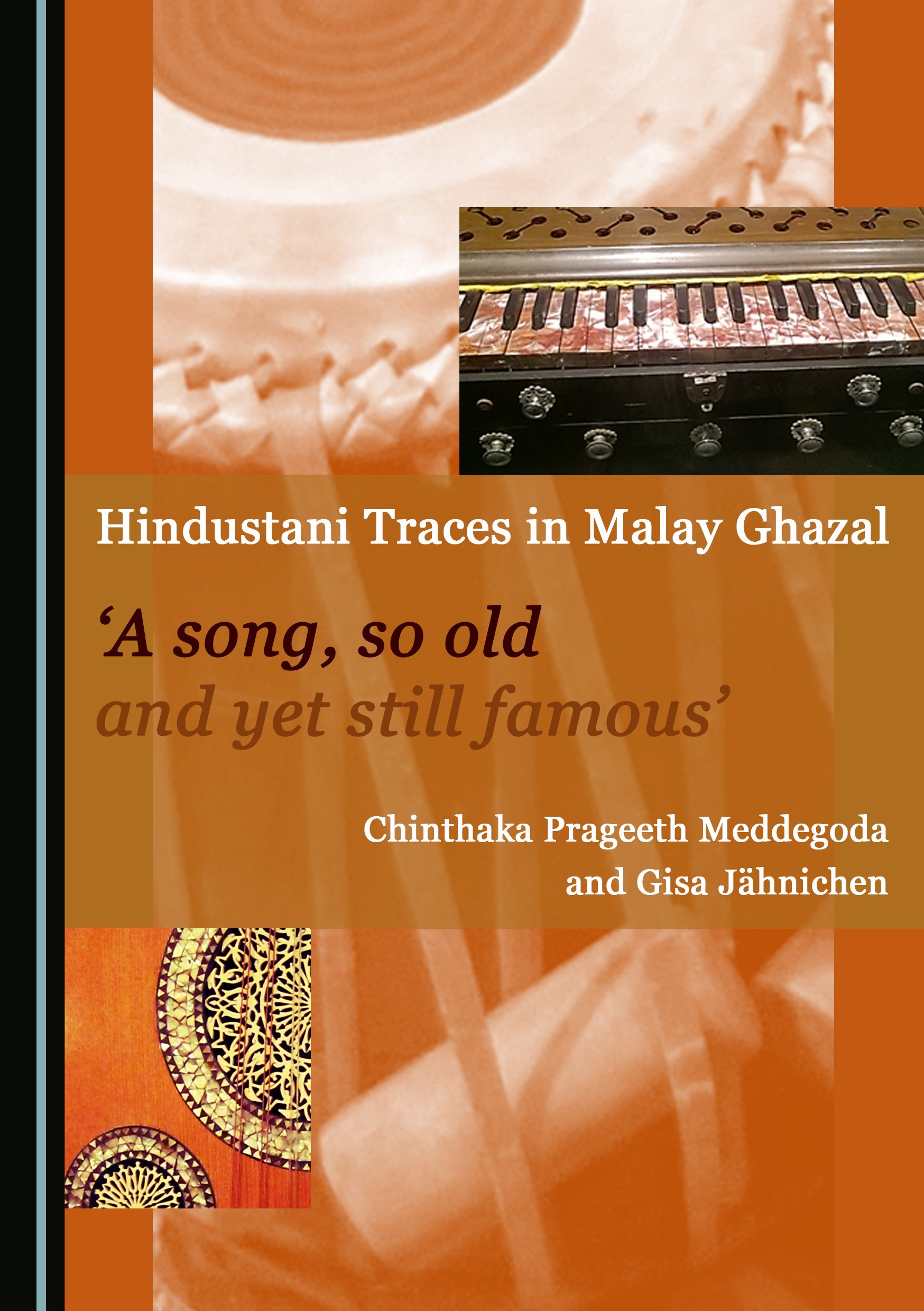
Hindustani Traces in Malay Ghazal

'A song, so old and yet still famous'
By: Gisa Jähnichen, Chinthaka Prageeth Meddegoda

£63.99

This monograph investigates the Malay ghazal, in its various shapes and with its different meanings, in order to study the musical traces of Hindustani culture. It describes the development of the ghazal, from its early forms to its modern transformation into local art.

‘A song, so old and yet still famous’ is a Malay expression of admiration for an exotic singing style, a musical contemplation on the beauty…
£63.99
£63.99
Share

‘A song, so old and yet still famous’ is a Malay expression of admiration for an exotic singing style, a musical contemplation on the beauty of nature, God, and love. The ghazal exists in manifold cultures all over Asia, Africa, and Southern Europe, and is intimately connected to Islam and its periphery. In each region, ghazals have been shaped into other expressions using imported features and transforming them into ‘local art’. In the Malay world, ghazals come in various shapes and with different meanings.

‘The song, so old’ is the song that came before the proliferation of mass media. The first ghazals that were heard in the Malay world might have been those ghazals performed by Hindustani musicians traveling in Southeast Asia. However, later on, the ghazal’s development was additionally triggered by mass media, with technological progress enhancing change in urban entertainment and introducing new sources of further adaptations. In this context, the second half line of the lyrics mentioned, ‘and yet still famous’, means that despite being old, the song is highly regarded as an art in itself. Malay ghazals are still attractive and musically demanding. They were traditionally not performed for mass appeal, but, rather, for a small knowledgeable audience that valued musical refinement and taste.

Chinthaka Prageeth Meddegoda is Lecturer of North Indian Music at the University of Visual and Performing Arts in Colombo, Sri Lanka. He is interested in popular and traditional music of various Asian cultures, as well as general issues of human society, philosophy and cultural studies. He has been a member of the International Council for Traditional Music (ICTM) since 2013, and has published several academic papers and presented research at international conferences in Japan, Indonesia, Laos, Germany, Malaysia, France, and Thailand.

Gisa Jähnichen has been conducting research on music for more than 25 years in South East Asia, and is currently working at the Shanghai Conservatory of Music. She obtained her PhD in Musicology and Ethnomusicology from the Humboldt University Berlin, Germany, and her professorial thesis (Habilitation) in Comparative Musicology from the University of Vienna, Austria. Extensive field research led her to Southeast Asia, East Africa, Southwest and Southeast Europe. Together with Laotian colleagues, she built up the Media Section of the National Library in Laos. In 2015, she was awarded a Distinguished Professorship at the Institute for Minority Arts Research of Guangxi Arts University, China. She is also Chairperson of a Study Group within the International Council for Traditional Music (ICTM) and Secretary of the Training and Education Committee in the International Association for Sound and Audiovisual Archiving (IASA).

Hardback

  • ISBN: 1-4438-9759-0
  • ISBN13: 978-1-4438-9759-4
  • Date of Publication: 2016-09-07

Ebook

  • ISBN: 1-4438-9998-4
  • ISBN13: 978-1-4438-9998-7
  • Date of Publication: 2016-09-07

Subject Codes:

  • BIC: AV, HRA, JFC
  • BISAC: MUS015000, MUS014000, MUS020000, MUS054000, MUS024000, MUS017000
  • THEMA: AV, QRA, JBCC
420
  • "The strength of the book is clearly in the middle three chapters, which offer an analysis of the musical and poetic details known to the musicians—and
    - sometimes, only to the trained musicologist, who is clearly the book’s intended reader. The prodigious effort that went into making the musical transcriptions alone deserves special praise...The transcription of the harmonium line provided in Chapter 5 (pp. 221–231) was exemplary precisely because it allowed for a comparison of vocal-harmonium interactions in both the Hindustani and Malay traditions, at length."

Meet The Author