• 0 Items - £0.00
    • No products in the cart.

£68.99

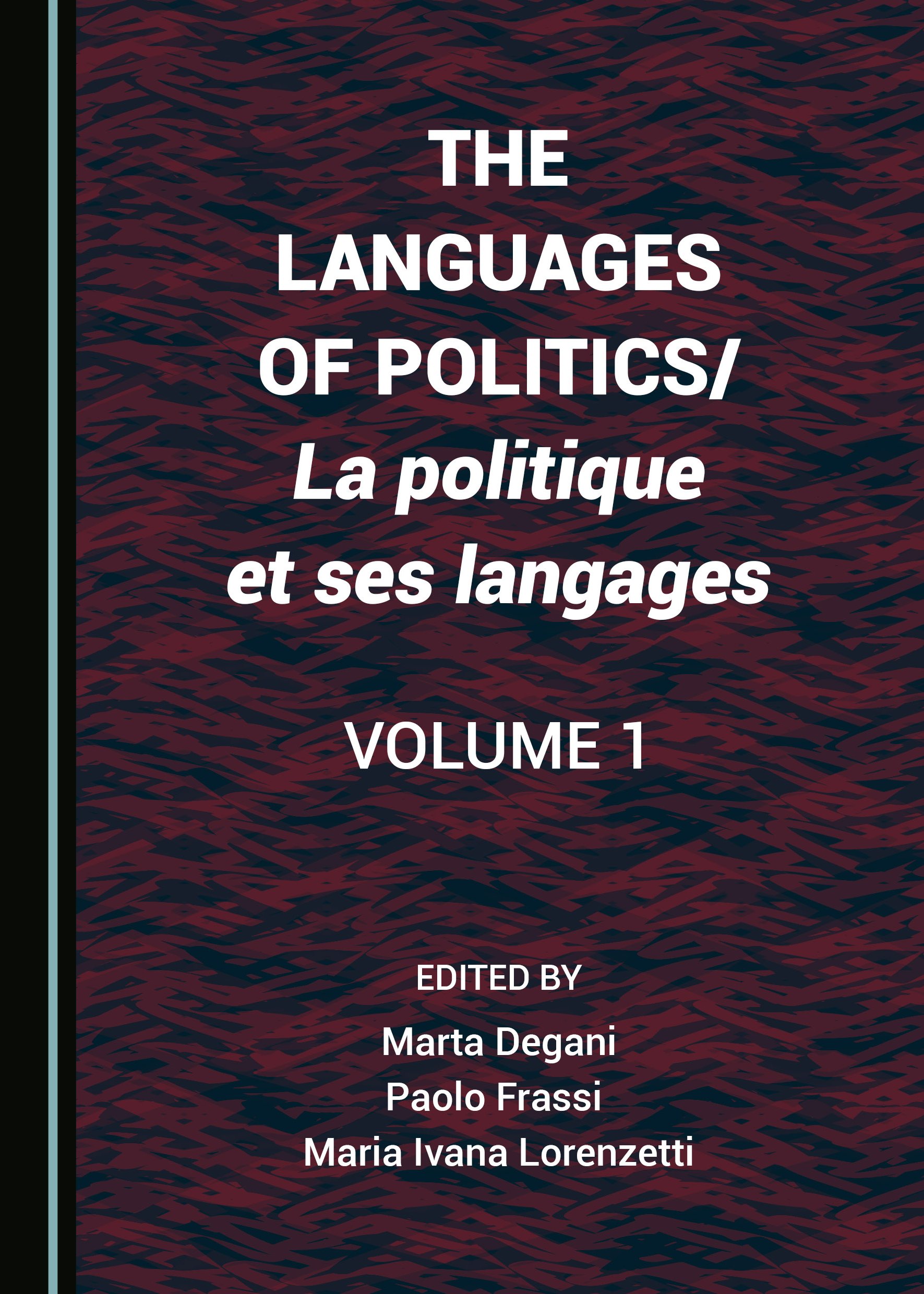
The Languages of Politics/La politique et ses langages Volume 1

Edited By: Marta Degani, Paolo Frassi, Maria Ivana Lorenzetti

£68.99

This two-volume book provides a multifaceted view of major approaches to the study of political discourse. It builds on previous political discourse perspectives and provides new insights into this research area, while combining theoretical and methodological considerations.

The Languages of Politics/La politique et ses langages provides a multifaceted view of major approaches to the study of political discourse from an interdisciplinary perspective.…
£68.99
£68.99
Share

The Languages of Politics/La politique et ses langages provides a multifaceted view of major approaches to the study of political discourse from an interdisciplinary perspective. To date, most contributions to the analysis of political discourse have come from the fields of rhetoric, (critical) discourse analysis, cognitive linguistics, pragmatics, lexicology, lexicography, and, more recently, multimodal discourse analysis. The papers in this volume build their investigations on these perspectives, and provide new and diversified insights into this vast area of research. Besides considering multiple approaches, the book also adds to the current debate on the languages of politics by combining a range of theoretical and methodological considerations, and by featuring contributions in both English and French.

Marta Degani is Associate Professor of English Language and Linguistics at the University of Verona, Italy. She holds a doctorate in English Studies from the University of Venice and an MA in Applied Linguistics from Macquarie University, Australia. She has researched extensively on the variety of New Zealand English, focusing on phenomena of linguistic and cultural contact between English and Maori. She has also worked on semantic and pragmatic aspects of English modality and published on issues of subjectification as a phenomenon of language change and (inter)subjectivity in verbal communication. She currently has two research foci: the analysis of political discourse in the frameworks of cognitive semantics and discourse analysis, and the study of bilingualism and biculturalism in the context of Aotearoa/ New Zealand.

Paolo Frassi is Associate Professor of French Language and Linguistics at the Department of Foreign Languages and Literatures of the University of Verona, Italy. His main research interests include lexicology, lexicography and language teaching. In particular, his studies concern lexicographical definitions, lexicographical metalanguage, metalexicography, vocabulary teaching for French L2 learners, and phrasemes. He collaborates with the RLF project (Réseau Lexical du Français) at the ATILF-CNRS Laboratory of Nancy, in which he attempts to model lexicographical definitions of adjectives.

Maria Ivana Lorenzetti is Assistant Professor in English Linguistics at the University of Verona, Italy. She received a PhD in English Linguistics from the University of Pisa, Italy, in 2006. Her main research interests are in the domains of political discourse, the syntax-semantics interface, textual analysis, cognitive linguistics, and translation.

Hardback

  • ISBN: 1-4438-9767-1
  • ISBN13: 978-1-4438-9767-9
  • Date of Publication: 2016-09-22

Ebook

  • ISBN: 1-4438-5764-5
  • ISBN13: 978-1-4438-5764-2
  • Date of Publication: 2016-09-22

Subject Codes:

  • BIC: CF, JPA, J
  • THEMA: CF, JPA, J
335
  • "This work does not shy away from the question of whether or not, and to what degree, we (the people) will be willing to continue to have trust to the media, the politicians, and indeed all wielders of influence in the present day and on into the future. The significance of this book is thus not merely that its contents report what is, or what has been, but that in it the authors offer the opportunity for us to consider what is yet to come, given the increasing use of qualitative analysis techniques that potentially evoke transparency, accountability, and ultimately those most prized human qualities of authenticity and integrity."
    - Professor David A Robinson, Holmes Institute