• 0 Items - £0.00
    • No products in the cart.

From £33.99

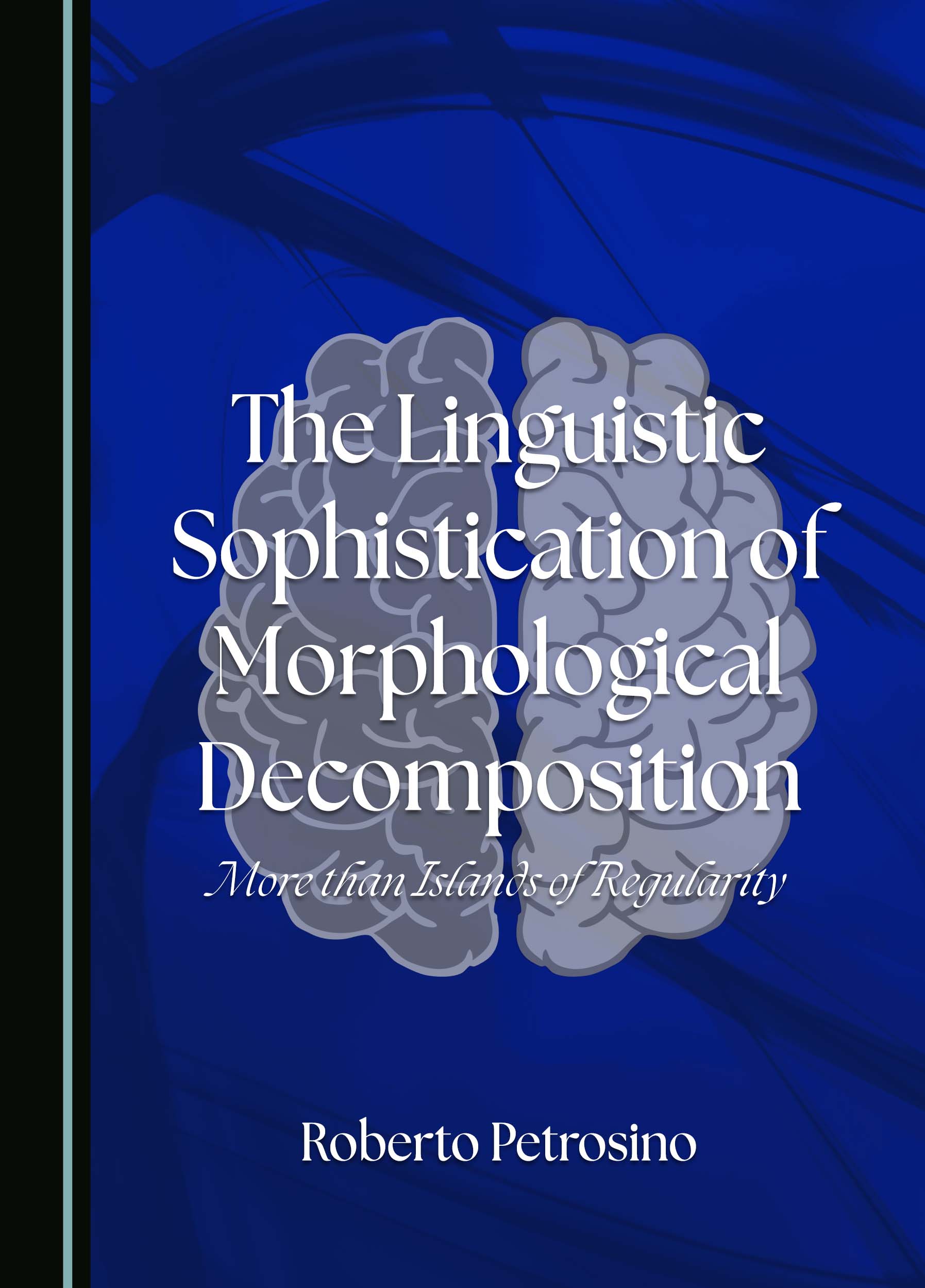
The Linguistic Sophistication of Morphological Decomposition

More than Islands of Regularity
By: Roberto Petrosino

From £33.99

How do we recognize words? Challenging the idea that we rely solely on visual patterns, this book proposes a novel model of lexical access. It posits a mechanism where the brain generates multiple decomposition patterns in parallel, then evaluates them to choose the optimal one.

A wealth of psycholinguistic evidence has shown that words, before being visually recognized, decompose into smaller orthographic units which may seem to correspond to, but…
From £33.99
From £33.99
Share

A wealth of psycholinguistic evidence has shown that words, before being visually recognized, decompose into smaller orthographic units which may seem to correspond to, but aren’t necessarily, morphemes. Such a procedure of morphological decomposition is commonly assumed to solely rely on islands of regularity – namely, statistical orthographic regularities, with no regard to the words’ meaning. Building on these results, the present investigation assesses the sensitivity of decomposition to non-semantic (i.e., phonological, lexical, and morpho-syntactic) properties, as a way to probe the time-course of visual word processing. In showing that decomposition may also be affected by whole-word lexicality and whole-word frequency, this book proposes a novel model of lexical access, in which decomposition encompasses a multi-step mechanism that first generates multiple possible morpho-orthographic decomposition patterns of the visual stimulus, and then evaluates them in parallel in order to choose the optimal candidate for activation.

Dr Roberto Petrosino obtained his PhD in Linguistics at University of Connecticut, USA. He is now post-doctoral researcher at New York University Abu Dhabi, United Arab Emirates. His specific theoretical interests lie within the domains of phonology and morphology, and in particular ask questions (i) about the informational richness of the phonological and morphological representations that are stored in the lexicon, and (ii) about the representational and computational relationships between alternants of morphological, phonological, and morpho-phonological alternations. He has published several peer-reviewed contributions in scientific journals. On the theoretical side, he has worked on several Indo-European languages (primarily, English and Italian, as well as Modern Greek, Classical Greek, and Latin). On the experimental side, he has worked primarily on English, by leveraging evidence from real-time word processing using both behavioral measures (primarily, lexical decision tasks, including both visual and auditory masked priming) and electrophysiological measures (in particular, electroencephalograms, or EEG).

Hardback

  • ISBN: 1-5275-8614-6
  • ISBN13: 978-1-5275-8614-7
  • Date of Publication: 2024-02-05

Paperback

  • ISBN: 1-0364-3210-6
  • ISBN13: 978-1-0364-3210-2
  • Date of Publication: 2024-12-13

Ebook

  • ISBN: 1-5275-8615-4
  • ISBN13: 978-1-5275-8615-4
  • Date of Publication: 2024-12-13

Subject Codes:

  • BIC: CF, CFD, JMR
  • THEMA: CF, CFD, JMR
206
  • “Petrosino’s book offers a seminal contribution to the discussion of morphological decomposition and processing. Framed around a coherent set of fundamental questions and around four hypotheses from the literature that generate distinct predictions, the book details a series of (chiefly) priming experiments aimed at addressing how different types of linguistic representations, from the phonological to the morpho-phonological to the syntactic, affect decomposition. The work is careful and thorough in its evaluation of competing hypotheses, transparent about methodological considerations, insightfully nuanced about the interpretation of its experimental results, and considerate of complex and outstanding issues in linguistic theory. Petrosino’s book deserves the attention of any researcher engaged with morphological topics, from psycholinguists to generative theorists.”
    - Luke Adamson Leibniz-Zentrum Allgemeine Sprachwissenschaft, Germany

Meet The Author