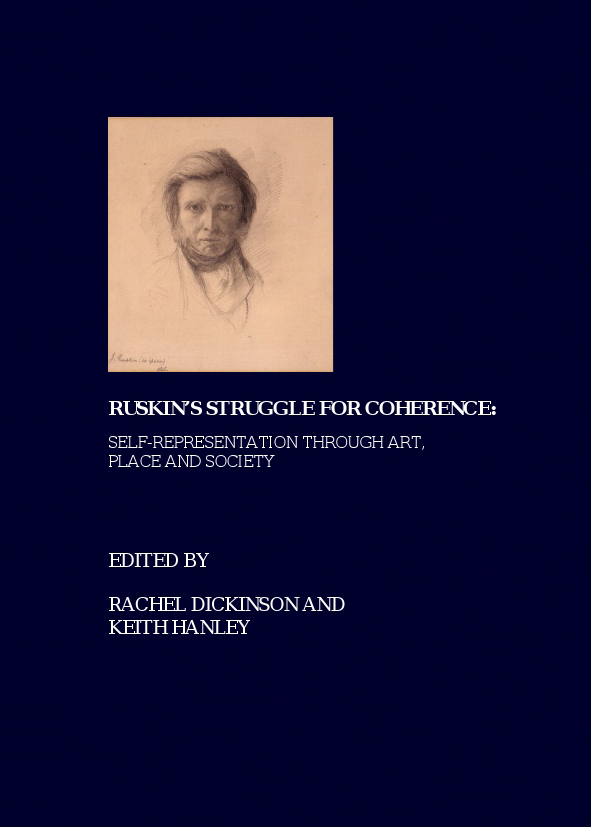
The writers of the ten essays collected here address a central problem in Ruskin studies—that of coherence in his multi-disciplinary works. They attempt to define the forms and mythic structure of his writings and to match what Ruskin himself refers to as the “polygon” of his thought with their interdisciplinary approaches. In differing degrees of application, these essays view it from the angles of art and literary criticism, aesthetics, formalism, myth criticism, cultural topography, history and geography, psychoanalysis, historicism, postructuralism, disability studies, neo-colonialism, and sociological and educational theory. As is explained in the editorial introduction, there is no pretension to completion, either individually or altogether, as that would ignore precisely what all Ruskin’s writings are finally about: what he called in a lecture of 1868 “The Mystery of Life and Its Arts”—that which no great artist or thinker has been able conclusively to pin down but which has effectively spurred all their intellectual and creative activities.
Tony Tanner’s essay, “Ruskin and the Sea”, is a virtuoso critical response to Ruskin’s response to both the sea and Turner’s paintings; Clive Wilmer’s “Ruskin and the Sense of an Ending: Apocalypse and Literary Form” is the exploration by a poet-critic of the interrelationship in Ruskin’s writing between time and spatiality; in “Sex and the City—Death in Venice: An Argument about Ruskinian Myth”, Robert Hewison takes issue with reductive autobiographical readings of The Stones of Venice; Keith Hanley’s “Ruskin’s Holy Land: the Sacred Language of Landscape” explores the representational content of some of Ruskin’s key places as adaptations of the critical sacred site of the Holy Land; Francis O’Gorman’s essay, “Ruskin’s Mountain Gloom”, confronts Ruskin’s increasingly anguished and disorientating awareness of the collapse of his early aspirations as a great cultural teacher; in “A Fine Grotesque or a Pathetic Fallacy? The Role of Objects in the Autobiographical Writing of Ruskin and Proust”, Alison Milbank celebrates the disjunction between the world of external objects and Ruskin’s subjectivism as the working of Ruskin’s “grotesque”; Deborah Sherman examines the same disjunctions in the light of trauma theory and disability studies by linking them to Ruskin’s late mental breakdowns and his final extended silence; in his essay, “Recontextualizing ‘The Two Boyhoods’: Ruskin, Thornbury and the Double Lives of Turner”, Andrew Leng argues that Ruskin attempted to retain for himself the kind of cultural wholeness he had once attributed to Turner’s art by exerting a controlling part in the first formal, two-volume Life of Turner by Walter Thornbury; David Thiele’s “Ruskin, Authority, and Adult Education” examines the contradictory tensions in Ruskin’s educational outlook in the context of “the Victorian movement for adult ‘self-culture’”, particularly in the practices and ideology of the London Working Men’s College; and in “Reading Unto This Last—A Transformative Experience: Gandhi in South Africa”, Judith M. Brown recounts the transformation of what was arguably Ruskin’s most influential political intervention, attributable partly to “the power and spread of the English language” and partly to the compatibility of what she calls “ideals rooted in the Hindu tradition.”