• 0 Items - £0.00
    • No products in the cart.

£34.99

Labor’s Canvas

American Working-Class History and the WPA Art of the 1930s
By: Laura Hapke

£34.99

Labor’s Canvas argues that New Deal art reveals important tensions. Artists saw themselves as cultural workers, yet struggled to reconcile social protest and aesthetics, often depicting laborers as bodies without minds and exposing cultural contradictions.

At an unprecedented and probably unique American moment, laboring people were indivisible from the art of the 1930s. By far the most recognizable New Deal…
£34.99
£34.99
1-84718-415-4 , ,
Share

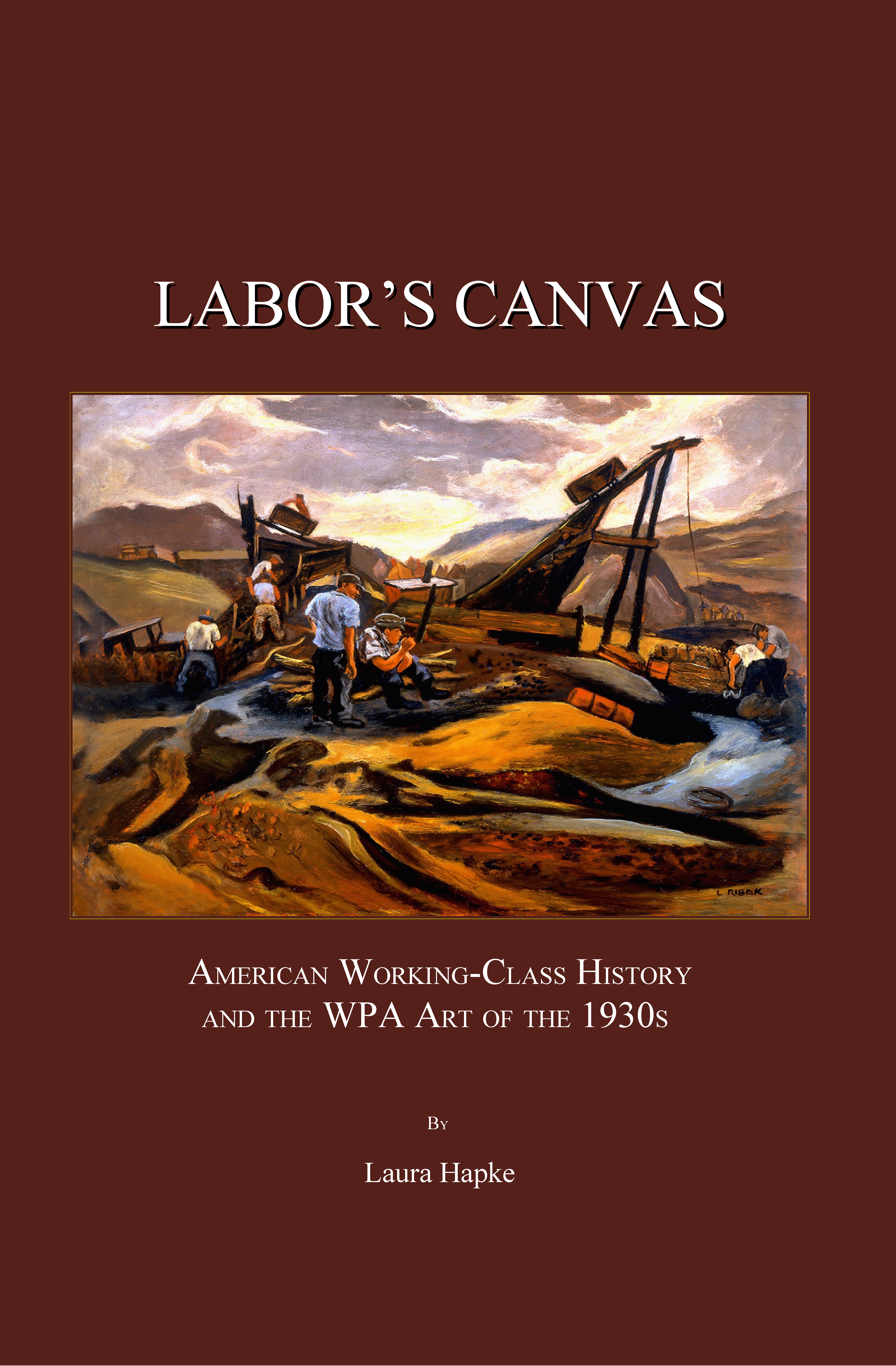
At an unprecedented and probably unique American moment, laboring people were indivisible from the art of the 1930s. By far the most recognizable New Deal art employed an endless frieze of white or racially ambiguous machine proletarians, from solo drillers to identical assembly line toilers. Even today such paintings, particularly those with work themes, are almost instantly recognizable. Happening on a Depression-era picture, one can see from a distance the often simplified figures, the intense or bold colors, the frozen motion or flattened perspective, and the uniformity of laboring bodies within an often naive realism or naturalism of treatment. In a kind of Social Realist dance, the FAP’s imagined drillers, haulers, construction workers, welders, miners, and steel mill workers make up a rugged industrial army.
In an unusual synthesis of art and working-class history, Labor’s Canvas argues that however simplified this golden age of American worker art appears from a post-modern perspective, The New Deal’s Federal Art Project (FAP), under the aegis of the Works Progress Administration (WPA), revealed important tensions. Artists saw themselves as cultural workers who had much in common with the blue-collar workforce. Yet they struggled to reconcile social protest and aesthetic distance. Their canvases, prints, and drawings registered attitudes toward laborers as bodies without minds often shared by the wider culture. In choosing a visual language to reconnect workers to the larger society, they tried to tell the worker from the work with varying success.
Drawing on a wealth of social documents and visual narratives, Labor’s Canvas engages in a bold revisionism. Hapke examines how FAP iconography both chronicles and reframes working-class history. She demonstrates how the New Deal’s artistically rendered workforce history reveals the cultural contradictions about laboring people evident even in the depths of the Great Depression, not the least in the imaginations of the FAP artists themselves.

Laura Hapke teaches at the New York City College of Technology, City University of New York. Dr. Hapke is the author of five previous books and numerous articles on the relation of American cultural production to laboring people. She is currently at work on an ideological history of the United States tenement.

Hardback

  • ISBN: 1-84718-415-4
  • ISBN13: 978-1-84718-415-3
  • Date of Publication: 2008-02-01

Ebook

  • ISBN: 1-4438-0851-2
  • ISBN13: 978-1-4438-0851-4
  • Date of Publication: 2008-02-01
270

Subject Codes:

  • BIC: HBJK, HBLW, HBTB
  • BISAC: ART015100, ART015020, ART037000, HIS036060, HIS054000, HIS036000
  • THEMA: NHK(3MP), NH, NHTB
270
  • “This elaborately detailed yet analytical work does for American labor art in the twentieth century what Hapke’s previously published Labor’s Text did for imaginative literature of the working class: it contextualizes, distinguishes among approaches, and explores the contradictions and singularities among the artists as well as their sponsors and partisans. The productions of the Federal Arts Project are shown to be anything but monolithic; the relationship of the art to trade unionism and the rise of the CIO is studied in depth, as is the struggle for presence among women and racial and ethnic minorities.
    - Hapke’s study is not only encyclopedic but constantly engrossing. In her keeping, the collective body and the individual face of the worker under representation are equally well served.” —John Crawford, publisher of West End Press (USA)

Meet The Author